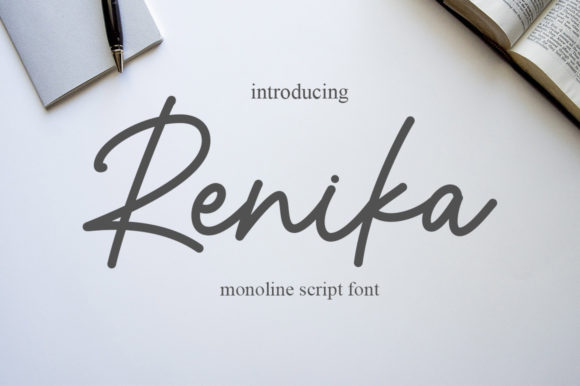
Renika: A Dainty Handwritten Font for Romantic, Personalized Designs
If you've ever scrolled through font marketplaces searching for something that feels like a love letter written in ink—not pixels—you’ve likely paused on Renika. It’s a dainty, flowing handwritten font with gentle curves, subtle inconsistencies, and a joyful rhythm that evokes sincerity and warmth. Designers reach for Renika when they want elegance without formality—think wedding invitations, boutique packaging, heartfelt greeting cards, or even soft-branded social media graphics for lifestyle brands.
Why Renika Stands Out (and Why That Can Be Misleading)
Renika isn’t just “cute.” Its charm lies in its intentional imperfection: slight variations in stroke weight, natural entry/exit flourishes, and a slightly uneven baseline—all hallmarks of authentic handwriting. That’s why it works so well for romantic or personal contexts. But here’s where assumptions start to trip people up.
Many assume that because Renika looks effortless, it will behave effortlessly across platforms and use cases. That’s not always true. For example, one designer ordered Renika for a client’s wedding suite—only to discover too late that the free trial version lacked essential OpenType features like ligatures and alternate characters. The final printed invitations looked stiff and repetitive, missing the nuanced flow the font was meant to deliver.
1. Assuming All Versions Are Equal
Renika is available in multiple formats: desktop (OTF/TTF), web (WOFF2), and sometimes as a variable font. But not all versions include the same character sets. The basic desktop version may cover Latin letters and common punctuation—but skip accented characters (like é, ñ, or ü), currency symbols, or discretionary ligatures. If your audience includes bilingual guests—or your brand uses non-English names—you’ll need the full Pro version.
Better approach: Before downloading or purchasing, check the specimen PDF or character map provided by the foundry. Look specifically for support of diacritics, numerals, and punctuation used in your project. If you’re designing for global audiences, verify multilingual coverage—not just “basic English.”
2. Overlooking Contextual Contrast
Renika shines when paired with clean, neutral typefaces—like a crisp sans serif for body text or headings. But some users try to pair it with other decorative fonts (say, another script or a bold display face), creating visual noise instead of harmony. Others use Renika for long paragraphs—a decision that sacrifices readability for aesthetics.
Renika isn’t built for body copy. Its fine strokes and delicate spacing blur at small sizes or on low-resolution screens. Using it for website navigation, email footers, or legal disclaimers often leads to squinting, missed details, or even accessibility issues for readers with visual impairments.
Better approach: Reserve Renika for short, high-impact text: names, dates, taglines, or callouts. Use it at 24pt or larger in print; 32px or larger on screen. Pair it intentionally—e.g., Renika for “Emma & James” and Inter or Lato for “Saturday, June 15th, 2025 • The Willow Garden.” Let each font do what it does best.
3. Skipping Licensing Clarity
This is where good intentions meet real-world risk. Renika is sold under commercial licenses—but not all licenses cover the same uses. A standard license might allow printed stationery and social posts, but *not* embedding in mobile apps, selling digital templates on Etsy, or using it as part of a logo that becomes a trademarked brand asset.
One small business owner used Renika in her logo, then later tried to register it with the USPTO—only to learn the font license didn’t permit trademark use. She had to rebrand at significant cost.
Better approach: Read the license terms *before* finalizing your design. Ask yourself: Will this be printed? Shared digitally? Embedded in software? Sold as part of a product? If you're unsure, contact the foundry directly. Reputable sellers (like Creative Market, MyFonts, or the designer’s own site) usually clarify usage tiers clearly—and many offer extended licenses for logos, apps, or unlimited projects.
What to Test Before You Commit
Before adding Renika to your toolkit—or investing time in a full design—run these quick checks:
- Test legibility at real size: Paste your actual headline into a mockup at its intended size and view it on both desktop and mobile. Does “forever & always” stay graceful—or does the ampersand vanish into the curve of the “r”?
- Check spacing in context: Renika’s default kerning works beautifully for English names, but may tighten awkwardly around certain letter combinations (like “To” or “We”). Adjust tracking manually if needed—don’t assume auto-kerning handles every phrase.
- Verify file integrity: Some free downloads bundle Renika with outdated or corrupted files. Always install from the original source—and open the font in a character map tool to confirm glyphs render cleanly.
- Assess workflow fit: If you work in Canva or Figma, confirm Renika supports those platforms natively—or whether you’ll need to convert to outlines (which limits future edits).
A Final Note on Intentionality
Renika isn’t a shortcut to “romance” or “personality.” It’s a tool—one that rewards thoughtful application. Its strength isn’t in how much it draws attention, but in how quietly it deepens emotional resonance. When used with care, it helps people feel seen: a bride recognizing her name in elegant, unhurried strokes; a customer pausing over a hand-lettered note tucked inside a package; a reader smiling at the warmth behind a simple “thank you.”
That effect doesn’t come from installing the font—it comes from understanding its voice, respecting its limits, and aligning it with purpose. So before you type your first word in Renika, ask: Is this the right moment for delicacy? Is this message worth the pause it invites? If yes—then you’re already using it well.