Beverly Armistead: A Delicate Handwritten Font for Thoughtful Design Choices
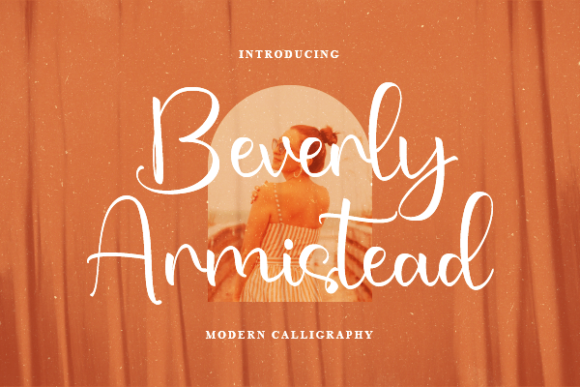
Beverly Armistead is a refined handwritten typeface distinguished by its elegant proportions, subtle contrast, and graceful swashes. It’s not merely decorative—it’s intentionally crafted to balance visual softness with structural clarity. Each character flows with a gentle rhythm, evoking the warmth of ink-on-paper craftsmanship while maintaining enough consistency for legibility at moderate sizes. Its daintiness isn’t fragility; it’s precision in restraint.
What Sets Beverly Armistead Apart
Unlike many script fonts that prioritize flourish over function, Beverly Armistead integrates swashes as expressive accents—not dominant features. The ascenders and descenders extend with quiet confidence, and the connecting strokes between letters are smooth but never overly tight. This makes it more versatile than ultra-fluid scripts (which can blur at smaller sizes) or tightly spaced calligraphic fonts (which may feel rigid or formal). Its lowercase ‘g’, ‘y’, and ‘j’ include delicate terminal swashes that enhance personality without sacrificing readability in short-form applications like monograms or envelope addressing.
The font includes standard OpenType features—ligatures, contextual alternates, and swash variants—allowing designers to fine-tune tone and emphasis. You’re not locked into one stylistic interpretation; instead, you can choose when to introduce a subtle flourish versus a cleaner baseline form, depending on context and hierarchy.
Fitting Into Real-World Design Workflows
Beverly Armistead shines where intimacy and intention matter: wedding stationery, boutique packaging labels, artisanal product tags, boutique letterheads, and small-batch greeting cards. It works especially well when paired with a clean, neutral sans serif (like Lato, Poppins, or Inter) for body text—creating contrast without competition. In those pairings, Beverly Armistead carries voice and identity, while the supporting type handles information delivery.
It’s less suited for long-form editorial use, UI interfaces, or signage requiring high scannability at distance. Its fine strokes and delicate spacing don’t scale well below 14pt in print or 18px on screen without careful testing—and even then, legibility diminishes in low-resolution environments or under poor lighting. That’s not a flaw; it’s a boundary, and recognizing it helps avoid misapplication.
Comparing With Similar Styles
Handwritten fonts fall across a spectrum—from casual brush scripts to formal copperplate revivals. Beverly Armistead sits toward the middle: more structured than spontaneous brush fonts (e.g., those mimicking marker or watercolor strokes), yet softer and more personal than formal pointed-pen revivals. Brush scripts often prioritize energy and motion, sometimes at the expense of even spacing or consistent x-heights—making them harder to set in tight layouts or multi-line headings. Formal scripts, by contrast, emphasize strict rhythm and symmetry, which can feel distant or ceremonial rather than approachable.
Beverly Armistead avoids both extremes. Its stroke modulation is gentle, not dramatic; its rhythm is natural, not metronomic. That makes it adaptable across contexts where tone must feel warm but not childish, refined but not stiff. For example, a small ceramics studio might use Beverly Armistead for its logo and product labels—evoking handmade care—while using a modest sans serif for care instructions and website navigation. A tech startup aiming for “human-centered” branding would likely find it too soft; a floral design studio launching a seasonal collection would find it resonant.
Practical Tradeoffs to Consider
- Legibility vs. Character: Beverly Armistead gains charm from its subtlety—but that same delicacy means it requires more white space and generous line height to breathe. Tight columns or dense layouts will mute its strengths.
- Medium Sensitivity: It performs reliably in high-resolution print (letterpress, foil stamping, premium matte stock) but can lose definition in digital ads with aggressive compression or on older mobile screens with limited pixel density.
- Licensing Clarity: As a commercial font, Beverly Armistead typically requires a desktop or web license depending on usage. Unlike free handwritten fonts—many of which lack kerning pairs, language support, or professional hinting—it includes extended Latin character sets and thoughtful spacing out of the box. That investment pays off in time saved adjusting tracking or manually fixing collisions.
When Beverly Armistead Is the Right Fit
Consider Beverly Armistead if your project centers on authenticity, craft, or emotional resonance—and if your audience values nuance over boldness. It fits naturally in scenarios where typography supports storytelling rather than dominating it: a memoir cover that whispers rather than shouts; an apothecary’s ingredient list that feels hand-noted; a boutique hotel’s welcome note that balances elegance with ease.
It also works well when brand voice leans toward understated sophistication—think independent bookshops, slow-fashion labels, or wellness practitioners who emphasize presence and detail. In those cases, Beverly Armistead reinforces values without needing explanation. Its quiet confidence aligns with audiences who respond to care in execution, not just concept.
When Another Option Might Serve Better
If your work involves frequent typographic hierarchy—such as newsletters with headlines, subheads, pull quotes, and captions—you’ll likely need more contrast than Beverly Armistead alone provides. A matched serif/sans pairing often delivers clearer structure. Likewise, if your audience skews younger or engages primarily via mobile devices, a bolder, more legible script—or even a semi-serif with handwriting-inspired details—may communicate more effectively in constrained spaces.
For projects requiring multilingual support beyond Western European languages, verify whether the Beverly Armistead version you’re evaluating includes Cyrillic, Greek, or extended diacritics. Not all releases do—and retrofitting missing glyphs isn’t feasible without custom font development.
Making an Informed Choice
Choosing a font like Beverly Armistead isn’t about finding the “best” option—it’s about matching expressive intent with functional reality. Ask yourself: What feeling should this text carry? Where will it be seen—and how much control do I have over size, background, and resolution? Who is reading it, and what assumptions might they bring about tone based on shape and weight?
Test Beverly Armistead in your actual layout—not just as a standalone sample. Try it at intended sizes on the intended medium: printed on your chosen paper stock, rendered on a mid-tier smartphone, projected in a dim room. Notice where letters merge, where swashes compete, where spacing feels generous versus awkward. Compare it side-by-side with two alternatives—one slightly bolder, one slightly simpler—to gauge relative impact and comfort.
Remember that typography functions best when it recedes just enough to let content lead—yet remains distinct enough to shape perception. Beverly Armistead does that quietly, consistently, and with intention. It won’t solve every design challenge, but where delicacy, sincerity, and hand-crafted nuance matter, it offers a reliable, graceful voice.