Sweet Rosie: A Curly Handwritten Font for Warm, Personal Design Projects
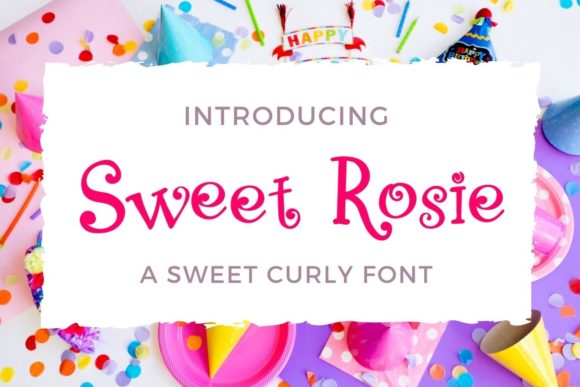
Sweet Rosie is a charming, curly handwritten font designed to evoke warmth, intimacy, and authenticity. Its letters flow with gentle loops, soft terminals, and subtle variations in stroke weight—characteristics that reflect natural pen-on-paper movement rather than rigid digital precision. Unlike many script fonts that prioritize flourish over function, Sweet Rosie balances decorative appeal with legibility at moderate sizes, making it especially well-suited for projects where personality and readability both matter.
What Sets Sweet Rosie Apart
At first glance, Sweet Rosie stands out for its consistent yet organic rhythm. Each character connects smoothly, but not all letters join by default—giving designers flexibility to choose between connected or spaced settings depending on context. Its curvature is generous but never exaggerated; the lowercase g, y, and q feature open, friendly descenders, while capitals carry just enough ornamentation to feel intentional—not overwhelming. This measured approach helps Sweet Rosie avoid the “overly cutesy” or “too formal” pitfalls common among handwritten typefaces.
It’s also built with practical use in mind: full Latin character support, standard punctuation, numerals, and basic OpenType features like ligatures and alternate characters. These aren’t just aesthetic extras—they help maintain visual harmony across longer phrases or mixed-case headlines, which matters when crafting wedding invitations or social media banners meant to be read quickly and remembered fondly.
Fitness for Real-World Use Cases
Sweet Rosie shines where emotional resonance supports the message. For wedding stationery, its gentle curves echo the tenderness of vows—ideal for names, dates, and short poetic lines. It pairs naturally with clean sans-serif companions (like Montserrat or Lato) for body text, creating contrast without tension. In this context, Sweet Rosie isn’t competing with ultra-thin calligraphic fonts or dense brush scripts—it occupies a middle ground: expressive enough to signal celebration, grounded enough to remain clear on printed cardstock or digital previews.
For social media graphics—especially Instagram carousels or Pinterest pins—Sweet Rosie adds human texture against flat layouts. Its slight irregularity draws attention without demanding it, supporting brand voices that value sincerity over polish. That said, it’s less effective for long-form captions or small mobile text, where its delicate spacing and fine details may blur or crowd. Users should test rendering across devices before finalizing designs.
Stationery art—think thank-you notes, journal covers, or boutique packaging—also benefits from Sweet Rosie’s tactile quality. Because it avoids extreme thinning or dramatic swashes, it scales well from 12 pt business cards to 60 pt wall prints without losing integrity. Designers report fewer revisions needed for kerning adjustments compared to more volatile script fonts, thanks to its thoughtful letterfit and balanced metrics.
Comparing Approaches: When Sweet Rosie Fits—and When It Doesn’t
Handwritten fonts fall into several broad categories: calligraphic (often high-contrast and formal), brush-style (bold, textured, energetic), and casual handwriting (loose, uneven, diary-like). Sweet Rosie sits closest to the last group—but with more consistency and structure than typical “casual” options. That makes it a pragmatic choice for creators who want handwritten charm without sacrificing control.
Compared to highly ornate scripts, Sweet Rosie trades grandeur for approachability. It won’t dominate a layout the way a dramatic copperplate might—but it also won’t recede into background noise like some minimalist handwritten fonts do. Its strength lies in complementing, not commanding. If your project relies on typography as a primary storytelling device—say, a luxury perfume label where every curve must whisper exclusivity—Sweet Rosie may feel too gentle. But for small businesses emphasizing care and connection (a family bakery, a wellness coach, a handmade ceramics studio), its warmth reads as genuine, not generic.
Likewise, while Sweet Rosie works beautifully in static design tools like Adobe Illustrator or Canva, it’s not optimized for dynamic environments like variable font axes or web-first typographic systems. It lacks variable weight or width options, so designers needing responsive scaling or real-time style switching will need fallback strategies. That’s not a flaw—it’s a reflection of its purpose: to serve as a carefully crafted, fixed-style voice within intentional compositions.
Practical Considerations for Implementation
Before licensing Sweet Rosie, consider how you’ll use it. Most licenses cover desktop use (for print and static digital files), but web or app embedding often requires separate permissions. Always verify usage rights based on your output format—especially if distributing templates or client deliverables.
Color and background matter more with Sweet Rosie than with bolder fonts. Its fine strokes can fade on low-contrast combinations (e.g., light gray on white), and busy textures behind it may distract from its flow. Test prints early: some inkjet printers soften its subtleties, while laser printers often preserve them better. For digital use, preview at actual size—not zoomed-in mockups—to assess clarity on retina and non-retina displays alike.
Pairing Sweet Rosie thoughtfully enhances its impact. Avoid stacking it with other highly decorative fonts; instead, lean into contrast. Try it with geometric sans-serifs for modern balance, or with soft serif bodies (like Merriweather or Cormorant Garamond) for editorial warmth. Steer clear of fonts with competing rhythms—another flowing script, for instance—unless you’re deliberately layering meaning through typography.
Who Benefits Most From Sweet Rosie?
Sweet Rosie tends to resonate most with designers and small-business owners who value craft but work under time constraints. Its reliability reduces trial-and-error: fewer kerning fixes, fewer legibility surprises, fewer client requests for “make it more readable.” It’s also popular among DIY creators—brides designing their own invites, teachers making classroom posters, or crafters labeling handmade goods—because it feels personal without requiring professional typesetting knowledge.
That said, it’s not universally ideal. If your brand voice leans toward authority, innovation, or stark minimalism, Sweet Rosie’s softness may dilute messaging. Similarly, projects targeting broad accessibility should weigh its limitations: while legible for most readers, its connected forms and narrow counters may challenge those with dyslexia or low vision—especially at smaller sizes or in low-light contexts. In those cases, pairing it with accessible body fonts—or choosing a more open, structured handwritten alternative—may be wiser.
Making an Informed Choice
Selecting a handwritten font involves more than aesthetics. It’s about tone alignment, technical fit, audience perception, and long-term usability. Sweet Rosie excels when warmth, sincerity, and quiet elegance are priorities—and when the design environment allows its subtleties to breathe.
Ask yourself:
- Does my project benefit from a human, hand-crafted impression—or does it require neutrality or authority?
- Will the font appear primarily in large, focused moments (an invitation headline, a logo lockup) or in extended, functional text (menus, instructions, websites)?
- Do I have the time and tools to adjust spacing, test outputs, and pair intentionally—or would a more forgiving, all-in-one font suit my workflow better?
Sweet Rosie doesn’t promise versatility across every scenario. Instead, it offers consistency within its lane: heartfelt, unhurried, and unmistakably hand-drawn. When matched to the right context—and supported by thoughtful design choices—it becomes more than typography. It becomes part of the story.