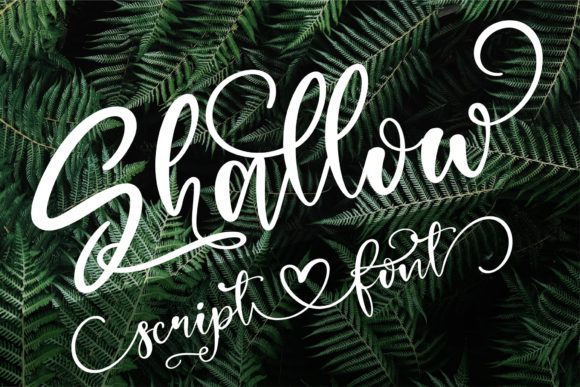
Shallow
There’s a quiet shift happening in how we communicate visually—less about shouting, more about whispering with intention. In an era saturated with bold sans-serifs, algorithm-optimized UIs, and AI-generated uniformity, designers, brands, and creators are turning to typefaces that carry humanity: subtle weight, organic rhythm, and unmistakable personality. Shallow arrives not as a trend-chaser, but as a thoughtful response to that growing need—a beautiful and light handwritten font with a unique feel and a stunning impact.
A Font That Breathes With Your Design
Shallow isn’t just “handwritten.” It’s deliberately light—not fragile, but confident in its restraint. Its strokes flow with gentle variation, avoiding mechanical repetition while preserving clarity at every size. That balance makes it unusually versatile: equally at home on a minimalist wedding invitation, a boutique skincare label, a podcast cover, or a carefully curated Instagram story. Unlike heavier script fonts that can dominate or overwhelm, Shallow supports without competing. It lets imagery, copy, or color take center stage—while still leaving a distinct, memorable impression.
What sets Shallow apart isn’t just aesthetics—it’s intentionality in execution. Every curve, terminal, and spacing decision reflects a commitment to legibility *and* character. It doesn’t sacrifice function for flair; instead, it proves the two can coexist seamlessly. For professionals who juggle brand consistency, accessibility considerations, and emotional resonance, that duality is rare—and valuable.
Why Handwritten Fonts Matter More Than Ever
We’re not returning to analog for nostalgia’s sake. We’re choosing authenticity because users expect it. Research consistently shows that audiences respond more positively to design elements perceived as human-made—especially in contexts where trust, care, or individuality matter (think wellness, education, creative services, or small-business branding). A 2023 Adobe Creative Cloud survey found that 68% of designers reported increased client requests for “warm,” “approachable,” or “personally crafted” visual language—up from 42% in 2019.
This isn’t about rejecting digital tools. It’s about using them to amplify human expression—not erase it. Tools like variable fonts, advanced OpenType features, and intuitive font managers have made expressive typography more accessible than ever. And Shallow fits right into that modern workflow: it’s PUA encoded, meaning you can access all of its glyphs and ligatures directly through your design software—no workarounds, no coding, no guesswork. Want a custom ampersand? A swash capital? An alternate ‘g’ that flows into the next word? It’s there, ready—without disrupting your rhythm.
Practical Use Cases Across Roles
For marketers and small business owners: Shallow helps differentiate in crowded feeds. A newsletter headline set in Shallow—paired with clean body text—signals thoughtfulness and care. It subtly tells subscribers, “This wasn’t mass-produced. This was chosen.” That perception builds credibility faster than any stock photo.
For educators and course creators: Visual hierarchy matters when learners scan content. Shallow works beautifully for section headers or key takeaways—light enough not to fatigue the eye, distinctive enough to act as visual anchors. When used sparingly (e.g., only for module titles or quote callouts), it reinforces structure while keeping tone warm and inclusive.
For freelancers and agencies: Clients increasingly ask for “brand personality”—not just logos and palettes, but tonal consistency across touchpoints. Shallow serves as a flexible typographic signature: use it for hero text on websites, then switch to a neutral sans-serif for body copy. That contrast creates sophistication without complexity. And because it’s well-spaced and finely hinted, it renders cleanly across devices—from high-DPI screens to email clients with limited font support.
For bloggers and content creators: Your voice is your biggest asset. Shallow helps translate tone into visual form. A reflective personal essay benefits from its soft cadence; a lighthearted lifestyle post gains charm from its playful ligatures. Even in static formats like PDF guides or printable planners, Shallow adds tactile warmth that feels intentional—not decorative.
How Shallow Fits Into Evolving Creative Workflows
Design tools have changed dramatically in the past five years. Figma now supports OpenType features natively. Canva added custom font uploads for Pro users. Even Google Docs allows embedded web fonts via add-ons. What used to require developer hand-holding—or compromise—is now part of the everyday toolkit. Shallow was built for this reality: lightweight file size, broad format support (.otf, .woff2, .ttf), and reliable cross-platform behavior.
More importantly, it respects the creator’s time. PUA encoding eliminates the need to hunt for special characters in glyph panels or memorize obscure keyboard shortcuts. In Figma or Illustrator, typing “ff” might automatically trigger a connected ligature; selecting a word and applying the “stylistic alternate” feature swaps in a refined version of “a” or “e.” These aren’t gimmicks—they’re time-savers that preserve craft. You spend less time engineering appearance and more time refining message.
Not Just for “Pretty” Projects
It’s easy to assume a light handwritten font belongs only on wedding stationery or artisanal coffee bags. But consider real-world adaptations: a mental health app using Shallow for onboarding tips (softness signals safety); a nonprofit annual report setting quotes from beneficiaries in Shallow (humanizing data); a university department using it for event posters (adding approachability to academic rigor). The key isn’t where you use it—but *why*. Shallow earns its place when the goal is connection, not decoration.
That said, restraint remains essential. Like any expressive typeface, overuse dilutes impact. Pair it intentionally: with generous whitespace, muted palettes, or strong photographic contrast. Avoid stacking multiple script fonts or forcing it into dense UI labels. Its strength lies in contrast—in being the quiet note that makes the whole composition resonate.
Looking Ahead—Without Overpromising
Typography won’t solve engagement drops or build trust overnight. But consistent, considered choices compound. Choosing Shallow isn’t about chasing virality—it’s about aligning your visual language with values your audience already cares about: authenticity, care, and clarity. As AI tools accelerate production, the human signal becomes *more* distinguishable—not less. A font like Shallow doesn’t fight automation; it gives creators a reliable, expressive tool to retain authorship in fast-moving workflows.
And it’s evolving alongside us. Foundries increasingly release fonts with expanded language support, improved hinting for screen use, and responsive variants (like lighter or bolder weights optimized for specific contexts). While Shallow currently focuses on its core expressive range, its architecture suggests room for thoughtful expansion—without sacrificing what makes it distinctive.
Getting Started Thoughtfully
If you’re evaluating Shallow for a project, start small. Try it in one high-impact context first: a logo lockup, a social media banner, or a key section header. Test it across devices. Ask a colleague or trusted client: “What feeling does this evoke?” Their answer may reveal more than any spec sheet.
Remember: the best fonts don’t draw attention to themselves—they deepen understanding. Shallow succeeds because it feels effortless, even though it’s meticulously crafted. It carries luxury not through excess, but through precision and poise. In a world that often mistakes volume for value, choosing lightness—done well—is quietly revolutionary.