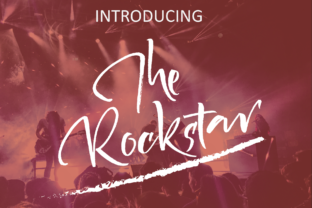
The Rockstar
If you’ve ever stared at a blank mockup, wondering how to make a logo feel warm and human—or tried to design an Instagram story that doesn’t look like every other one—you’re not alone. That’s where The Rockstar steps in: a handwritten brush font built from real strokes, real ink, and real intention. It’s not just another script font with uniform curves and predictable spacing. It’s a collection of over 700 handmade glyphs—letters, numbers, punctuation, alternates, ligatures, and decorative flourishes—all drawn by hand, then carefully digitized to preserve texture, pressure variation, and organic rhythm.
When You Need Personality, Not Perfection
Think about the last time you saw a café sign painted on reclaimed wood, or a wedding invitation with ink that bled just slightly at the edges. Those details don’t scream “professional” in a sterile way—they whisper authenticity. The Rockstar delivers that same grounded, human energy digitally. It works especially well when your goal isn’t to disappear into clean minimalism, but to stand out with warmth and character.
For Small Business Owners Building Trust
A local pottery studio launching its first website might use The Rockstar for its tagline (“Hand-thrown. Heart-led.”) while keeping body text in a neutral sans-serif. The contrast feels intentional—not trendy for trend’s sake, but thoughtful. Customers see craftsmanship in the font choice before they even read the “About” page. Similarly, a freelance therapist using The Rockstar for her newsletter header (“You Belong Here”) adds subtle emotional resonance without overdesigning. It signals care, not chaos.
For Educators Making Learning Feel Approachable
Teachers creating printable worksheets or digital lesson slides often default to fonts that are legible—but forget that tone matters too. A middle school science teacher used The Rockstar for section headers like “Let’s Investigate!” and “Your Turn to Observe.” Students reported the materials feeling “less like homework, more like a conversation.” That’s not magic—it’s the font’s natural flow and slight irregularity mirroring how people actually write ideas down during brainstorming or note-taking.
For Bloggers & Content Creators Who Want Visual Consistency
Imagine running a lifestyle blog focused on slow living and seasonal cooking. Your Instagram grid uses muted tones, linen textures, and candid photos. Dropping in a bold, rigid sans-serif for quote graphics would clash. But The Rockstar, paired with soft shadows and off-white backgrounds, reinforces your aesthetic across platforms—without needing custom illustration for every post. One creator told us she replaced her go-to “free download” script font with The Rockstar and immediately noticed higher engagement on quote carousels. Not because it’s flashy—but because it felt *of a piece* with her voice.
What Makes It Work Where Other Handwritten Fonts Fall Short
Many brush fonts sacrifice readability for flair—or worse, consistency for “uniqueness.” The Rockstar avoids both traps. Its lowercase ‘a’, ‘g’, and ‘s’ have clear, distinct shapes—even at small sizes. Its uppercase letters maintain strong presence without overwhelming. And because it includes multiple stylistic alternates (like a swash ‘Q’ or a looping ‘y’), you can fine-tune tone: playful for a kids’ activity kit, elegant for a boutique skincare label, grounded for a nonprofit’s annual report cover.
It also handles real-world constraints. Unlike some display fonts that break in email clients or older design tools, The Rockstar is OpenType-friendly and exports cleanly across Figma, Adobe Creative Cloud, Canva (via upload), and even Google Docs (with limited formatting). No need to convert to outlines unless you’re prepping final print files—and even then, its vector paths stay crisp.
Where to Use It—and Where to Pause
The Rockstar shines in short-form, high-impact applications: logos, headlines, social media graphics, packaging accents, presentation titles, greeting cards, merch designs, podcast cover art, and email subject lines. It’s less ideal for long paragraphs, legal disclaimers, data tables, or interfaces requiring rapid scanning (like app navigation labels).
Before dropping it into your next project, ask yourself two things:
- Is this the first thing people will read? If yes—and it’s meant to convey approachability, creativity, or care—The Rockstar is likely a strong fit.
- Does it support, rather than compete with, my message? A handwritten font on a cybersecurity whitepaper title might unintentionally undercut seriousness. But on a workshop flyer titled “Build Confidence, Not Code”—it lands perfectly.
Real Choices, Not Just Aesthetic Ones
Using The Rockstar isn’t just about picking a pretty typeface. It’s a small but meaningful decision about how you want people to feel when they encounter your work. A wedding planner using it for client onboarding emails tells us couples reply faster—and with warmer language. A craft brewery applied it to tap handle labels and saw repeat visitors comment, “It feels like you made this just for us.”
That’s the quiet power here: The Rockstar doesn’t shout. It invites. It doesn’t replace strategy—it deepens it. When your brand voice is warm, your teaching style is encouraging, your content aims to connect rather than impress, or your product celebrates human-made imperfection, this font becomes part of your toolkit—not as decoration, but as reinforcement.
And if you’re weighing whether to invest in it versus free alternatives? Consider how much time you spend tweaking letter-spacing, hunting for alternate glyphs, or redrawing headlines in Illustrator to get the right vibe. With The Rockstar, those adjustments are already baked in—thoughtfully, consistently, and with room to breathe. You’re not buying characters. You’re buying confidence in your choices—and clarity in how others experience them.