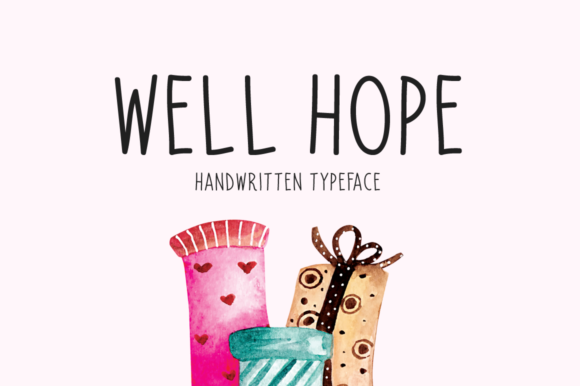
Well Hope: Handwritten Charm for Real-World Design
If you’ve ever stared at a blank chalkboard—or its digital twin—wondering how to make your message feel warm, intentional, and unmistakably human, Well Hope might be the quiet solution you’ve overlooked. It’s not flashy. It doesn’t come with 20 stylistic alternates or built-in animations. What it does offer is something increasingly rare in today’s design landscape: authenticity, clarity, and quiet confidence—all wrapped in a single, thoughtfully drawn handwritten font.
A Font That Feels Like a Thought, Not a Template
Well Hope is a clean, lettered handwritten typeface designed with deliberate simplicity. Every curve, slant, and spacing decision reflects real pen-on-paper rhythm—not algorithmic mimicry. There are no exaggerated flourishes or forced imperfections. Instead, you get consistent baseline alignment, gentle contrast between thick and thin strokes, and natural letter connections that invite readability without sacrificing personality.
This isn’t “hand-drawn” as a trend—it’s hand-drawn as a practice. The lowercase a, g, and s follow classic cursive logic, while uppercase letters retain a friendly, approachable weight. Kerning is balanced for both short quotes and longer passages, and the font includes standard Latin characters plus common punctuation—no surprises, no missing glyphs mid-project.
Where Well Hope Fits—Without Trying Too Hard
Because Well Hope avoids extremes, it works where other handwritten fonts stumble: in context, not just as decoration. Here’s where it consistently delivers:
- Educators and trainers: Use it for classroom posters, weekly learning goals on whiteboards, or printed reflection prompts. Its legibility at 24–36pt means students don’t squint—and its warmth lowers the barrier to engagement, especially for younger learners or neurodiverse audiences.
- Small business owners and makers: Think price tags on artisan soap, workshop handouts, or seasonal menu boards. Unlike overly stylized scripts, Well Hope reads instantly at arm’s length and scales cleanly from 12pt body text to 72pt signage.
- Bloggers and content creators: Pair it with a neutral sans-serif (like Inter or Lato) for pull quotes, email headers, or Instagram story text overlays. Its subtle texture adds visual interest without competing with photography or illustrations.
- Nonprofits and community organizers: When messaging needs empathy—not polish—Well Hope conveys sincerity without sounding corporate or detached. A volunteer sign-up sheet or event flyer feels more like an invitation than an announcement.
Real Use Cases You Can Try Today
One teacher in Portland uses Well Hope for her “Question of the Week” board—printed on kraft paper and taped beside the door. Students stop, read, and often linger to jot down thoughts. She told us, “It doesn’t shout. It waits. And that changes how they show up.”
A local bakery in Asheville switched from a generic script font to Well Hope for their daily chalkboard menu. Foot traffic data showed no change—but staff reported more customers reading the full descriptions (“We added ‘locally roasted hazelnuts’ and people actually asked about them”). The font didn’t sell the pastry; it made the description feel trustworthy.
Freelance UX writers use Well Hope in early-stage wireframes—not for final UI, but to signal “this is a human voice, not system jargon.” It helps stakeholders focus on tone before typography becomes a distraction.
What Well Hope Doesn’t Do (and Why That Matters)
It won’t auto-generate swashes. It doesn’t include multilingual support beyond basic Western European languages. You won’t find variable axes or OpenType features for contextual alternates. And that’s intentional.
In professional environments where speed, consistency, and accessibility matter, over-engineered fonts often backfire. Too many options mean slower decisions. Too much ornamentation reduces scannability. Well Hope skips the noise. It gives you one reliable voice—one that works equally well on a laminated classroom poster, a PDF lesson plan, or a Canva social graphic.
Practical Tips Before You Install
Before adding Well Hope to your toolkit, consider these grounded observations:
- Test it at actual size: Render a sample at 18pt on your target medium—printed paper, tablet screen, or projector. Handwritten fonts can lose nuance when scaled down or rendered poorly by older printers.
- Check contrast: On dark backgrounds (like chalkboards), ensure stroke weight holds up. Well Hope performs best with light-on-dark or dark-on-light—avoid mid-tone greys unless you’re testing first.
- Pair intentionally: It shines next to unadorned sans-serifs (e.g., Manrope, Work Sans) or modest serifs (Cormorant Garamond). Avoid pairing with other handwritten or highly decorative fonts—they’ll compete, not complement.
- Licensing matters: Verify usage rights for your context—especially if embedding in client deliverables, SaaS platforms, or physical products. Most licenses cover desktop + web use, but commercial redistribution (e.g., selling templates with Well Hope pre-installed) usually requires an extended license.
When Simplicity Becomes Strategic
In a world saturated with AI-generated visuals and algorithmically optimized layouts, choosing Well Hope is a small but meaningful act of intention. It signals that you value clarity over clutter, humanity over hype, and utility over ornament.
You don’t need to overhaul your entire brand to benefit from it. Start small: swap out one headline font in your next newsletter. Redesign a single internal worksheet. Print a quote for your desk using Well Hope—not because it’s trendy, but because it feels like something you’d write yourself.
That’s the quiet strength of Well Hope: it doesn’t ask to be noticed. It asks to be understood—and in doing so, it earns attention the old-fashioned way: by showing up, clearly and kindly.