Every Way: A Handwritten Font with Elegant Flow and Timeless Character
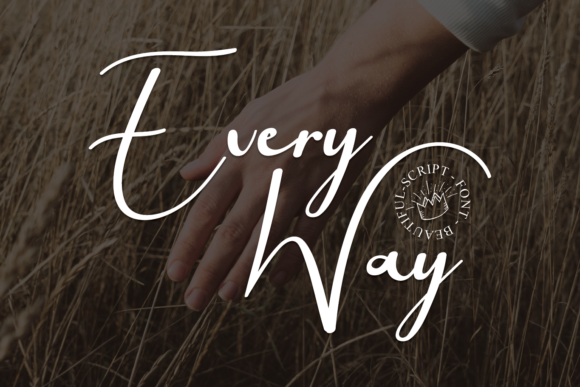
Every Way is a flowing handwritten font designed to evoke grace, intention, and quiet confidence. It’s not merely decorative—it’s crafted with rhythmic consistency, subtle variation in stroke weight, and natural-looking connections between letters. Unlike many script fonts that prioritize flair over function, Every Way balances expressiveness with legibility, especially at medium to large sizes. Its elegance comes not from ornamentation but from restraint: soft entry and exit strokes, gentle curves, and a sense of organic movement that feels hand-drawn yet carefully considered.
What Makes Every Way Distinct—Beyond Aesthetic Appeal
Distinctiveness in typography often lies in how a font behaves across real-world applications—not just how it looks on a specimen sheet. Every Way stands out because of its controlled spontaneity. Each character flows into the next with intentional continuity, but without forced ligatures or excessive alternates that can complicate layout. It avoids the “over-connected” trap common in some scripts, where letters blur together at smaller sizes or in dense text blocks. Instead, Every Way maintains clarity while preserving personality—even in all-caps settings or mixed-case headlines.
Its lowercase ‘a’, ‘g’, and ‘y’ carry classic, slightly rounded forms reminiscent of refined calligraphy, yet they avoid historical mimicry. That means it doesn’t read as “vintage” by default—making it adaptable across contexts, from modern wedding stationery to minimalist brand identities. The spacing is generous, supporting breathability in short phrases without needing manual kerning adjustments in most cases.
Where Every Way Fits Among Handwritten and Script Fonts
Handwritten fonts fall along a spectrum—from tightly controlled formal scripts to loose, energetic brush styles. Every Way occupies a thoughtful middle ground: more structured than expressive brush fonts (like those mimicking marker or chalk), yet more fluid and personal than upright connected scripts designed for corporate elegance.
Compared to highly stylized alternatives, Every Way offers greater versatility in pairing. It works well beside clean sans-serifs (e.g., Inter, Lato, or Poppins) without visual tension—its rhythm complements rather than competes. In contrast, some high-contrast scripts demand careful typographic hierarchy or risk overwhelming supporting text. Every Way’s moderate contrast and even texture allow it to hold presence without dominating a composition.
It also differs from utility-focused handwriting fonts—those optimized for UI labels, form fields, or small annotations. Every Way isn’t built for micro-legibility; it shines in environments where tone and impression matter most: logos, invitations, packaging accents, editorial headers, and social media visuals. Its strength lies in emotional resonance, not functional neutrality.
Strengths You Can Rely On
- Consistent voice: Delivers cohesive tone across varied applications—no sudden shifts in energy or form that disrupt brand continuity.
- Design-friendly metrics: Thoughtful side bearings and standard OpenType features (including basic ligatures and stylistic alternates) reduce time spent fine-tuning spacing.
- Print and screen resilience: Performs reliably in both high-resolution print and web use—especially when embedded via variable-weight webfont kits or static files with appropriate hinting.
- Timelessness over trendiness: Avoids exaggerated swashes or ultra-thin terminals that date quickly, making it a safer long-term choice for enduring branding.
Tradeoffs Worth Acknowledging
No font excels universally—and Every Way is no exception. Its deliberate flow makes it less suitable for extended body text. Paragraphs set entirely in Every Way would strain readability and dilute impact. Similarly, its emphasis on elegance means it may feel too soft or understated for projects requiring boldness, urgency, or technical authority—think safety signage, data dashboards, or instructional manuals.
While it includes standard Latin characters and basic punctuation, users working with multilingual content should verify glyph coverage. Every Way does not include extensive diacritic sets, Cyrillic, or extended Greek support out of the box—so international branding efforts may require supplemental typefaces or custom extensions.
Also worth noting: Every Way thrives in intentional placement. It rewards thoughtful hierarchy and whitespace. Dropping it into a cluttered layout or pairing it with overly busy imagery can mute its effect. Its elegance is amplified—not diminished—by simplicity elsewhere in the design.
When Every Way Is the Right Choice
Every Way suits projects where authenticity, warmth, and refinement are central goals. Consider it for:
- Wedding or event branding—where tone matters as much as information;
- Luxury product packaging (e.g., artisanal skincare, small-batch beverages) seeking approachable sophistication;
- Editorial features or book covers aiming for literary or human-centered storytelling;
- Personal portfolios or creative agency websites wanting to signal craftsmanship without cliché;
- Social media graphics where visual cohesion and emotional connection drive engagement.
In each case, Every Way contributes meaning—not just decoration. It signals care in execution and respect for the audience’s perception. That’s especially valuable when differentiation hinges on feeling, not features.
When Another Option Might Serve Better
Every Way isn’t ideal for every scenario—and recognizing that is part of using type thoughtfully. If your project requires:
- High legibility at small sizes: For captions, footnotes, or interface labels, a more neutral, humanist sans-serif or a low-contrast serif will serve readers more effectively.
- Strong visual contrast or dramatic emphasis: Fonts with sharper angles, bolder weights, or pronounced contrast (e.g., Didone serifs or geometric display faces) may better suit campaigns demanding attention or urgency.
- Multilingual or technical documentation: When broad language support, monospaced alignment, or strict accessibility requirements apply, Every Way’s stylistic focus becomes a limitation—not a benefit.
- Dynamic or interactive typography: While Every Way works well statically, it lacks variable-axis flexibility (like optical size or grade axes), so adaptive layouts requiring real-time weight or width modulation may need alternatives.
Practical Tips for Evaluating Every Way in Context
Before committing, test Every Way against your actual content—not placeholder text. Try it with your brand’s tagline, a key headline, and one representative subheading. Render it at intended sizes on both screen and print proofs. Ask: Does it support the message—or distract from it?
Compare it alongside two other options: one more neutral (to gauge contrast needs), and one more expressive (to clarify where Every Way lands on the personality scale). Pay attention not just to individual letters, but to how word shapes behave—especially repeated consonants like “tt”, “ll”, or “ss”, which can reveal spacing quirks.
Finally, consider licensing scope. Every Way is typically offered under desktop, web, and app licenses—with usage limits tied to pageviews or installations. If your project spans multiple platforms or high-traffic digital properties, confirm scalability upfront.
A Font That Earns Its Place—Not Just Fills Space
Every Way doesn’t shout. It invites closer attention. Its value emerges not in isolation, but in relationship—to the words it carries, the colors it sits beside, and the people who encounter it. That makes it especially well-suited for designers and brands prioritizing resonance over reaction, craft over convenience, and longevity over novelty.
Choosing Every Way isn’t about selecting the most ornate or trendy option—it’s about choosing a tool that aligns with how you want your work to be experienced: quietly confident, thoughtfully made, and unmistakably human.