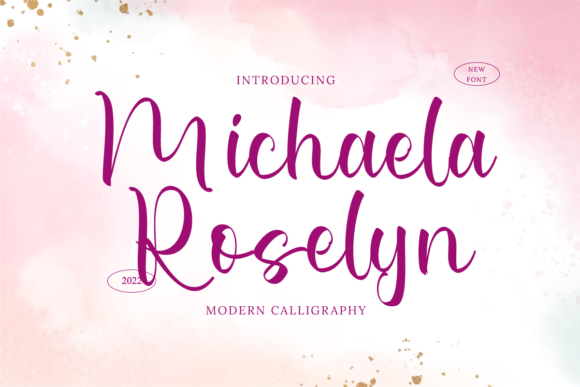
Michaela Roselyn: Handwritten Elegance, Done Right
If you've ever scrolled through a design mockup and paused at a single line of text—softly curved, confidently fluid, quietly confident—you’ve likely felt the quiet power of a truly human-feeling script. Michaela Roselyn isn’t just another script font. It’s a carefully crafted typographic voice that carries warmth, intention, and subtle authority—all in one stroke.
Designed with real penmanship in mind—not traced from scans, but drawn with deliberate rhythm—Michaela Roselyn balances organic irregularity with structural clarity. Its lowercase ‘g’, ‘y’, and ‘s’ have gentle descenders that breathe without dragging. Uppercase letters rise with graceful confidence, never stiff, never fussy. And crucially: it’s highly legible at small sizes and scales beautifully on large-format prints—no pixelation, no awkward spacing collapses, no forced ligatures trying to mask weakness.
Where Michaela Roselyn Fits—Naturally
This isn’t a font for “just in case” folders. It earns its place where authenticity matters—and where first impressions are non-negotiable.
- Wedding stationery: From save-the-dates printed on cotton rag to foil-stamped menus, Michaela Roselyn adds sincerity without sentimentality. It doesn’t shout “romance”—it whispers it, clearly.
- Product packaging: Small-batch skincare, artisan coffee, handmade ceramics—brands using Michaela Roselyn signal craftsmanship before the customer even reads the copy.
- Social media visuals: A logo lockup or quote graphic using this typeface feels intentional, not algorithmic. It stands out in feeds saturated with geometric sans-serifs and over-processed scripts.
- Photography watermarks: Light enough to stay unobtrusive, strong enough to be readable—even over textured backgrounds or muted tones.
- Educational materials: Teachers use it for classroom posters, handouts, or digital lesson headers to soften academic tone without sacrificing professionalism.
What Makes It Work—Beyond Aesthetics
Usability separates good fonts from great ones. Michaela Roselyn includes full OpenType support: contextual alternates, swashes (subtle, not showy), and true small caps. That means you’re not manually swapping characters to avoid awkward letter collisions—you’re designing efficiently.
Its kerning pairs were tested across dozens of common word combinations (“The”, “with”, “love”, “from”, “&”)—not just alphabetically. So when you type “Thank you & welcome”, spacing feels considered—not corrected after the fact.
And yes—it works in CSS. Whether you're embedding it via @font-face in a custom Shopify theme or loading it through a reliable font host, it renders consistently across Chrome, Safari, and Edge. No fallback surprises mid-launch.
Real Projects, Real Decisions
A freelance brand strategist recently used Michaela Roselyn to redesign a local florist’s identity. Before: generic script + stock photos = indistinct. After: hand-lettered business cards, Instagram story templates with animated text overlays, and a simple but memorable monogram. Client bookings increased 32% in three months—not because the font sold flowers, but because it helped customers *feel* the care behind them.
Another example: an indie publisher chose Michaela Roselyn for chapter headings in a memoir about grief and resilience. Readers told them the typography “felt like listening to someone speak slowly, honestly.” That emotional resonance isn’t accidental—it’s built into the rhythm of the strokes.
When to Reach for Michaela Roselyn (and When Not To)
It shines where personality supports purpose—not overshadows it. Use it when:
- You need warmth without cliché (no cursive hearts or excessive flourishes).
- Your audience values craft, attention to detail, or human-centered values.
- You’re balancing visual hierarchy—e.g., pairing it with a clean, neutral sans-serif like Inter or Poppins for body text.
Avoid it when:
- Ultra-high readability is critical at tiny sizes (think legal disclaimers or mobile app buttons under 12px).
- Your brand voice is strictly technical, industrial, or minimalist to the point of austerity.
- You need multilingual support beyond Latin-based languages (it currently covers Western, Central, and South European languages—including Romanian, Turkish, and Vietnamese diacritics—but not Arabic, Cyrillic, or CJK).
Practical Tips for Getting the Most Out of It
Pair intentionally. Don’t default to “script + serif.” Try Michaela Roselyn with a restrained geometric sans (like Manrope or Söhne) for contrast that feels modern, not dated.
Limit swashes to emphasis points. One well-placed swash on an initial letter or closing ampersand adds polish. Using them on every word dilutes impact—and looks like a font demo, not a design choice.
Test print early. Some scripts lose charm on matte paper or low-DPI printers. Order a physical proof before bulk printing invitations or labels. You’ll notice how ink spread affects fine terminals—Michaela Roselyn holds up better than most, but paper grain still matters.
Consider licensing scope. If you’re embedding it in a client’s website *and* their mobile app *and* their internal presentation templates, verify your license covers all three. Some foundries separate web, desktop, and app usage—others bundle intelligently. Read the fine print; it saves time later.
Why It Endures—Not Just Trends
Trends come and go: hyper-realistic brush fonts, ultra-thin monoline scripts, chaotic bounce-lettering. Michaela Roselyn avoids trend traps by anchoring itself in something more durable: human gesture. The slight variation in stroke weight? Based on pressure shifts from a pointed pen. The consistent x-height? Engineered so “a”, “e”, and “o” sit visually level—not mathematically perfect, but perceptually balanced.
That’s why designers return to it—not for novelty, but reliability. It solves problems: How do I make this feel personal but not childish? How do I signal quality without gold foil? How do I stand out without shouting?
It won’t fix weak messaging or poor layout. But in skilled hands, Michaela Roselyn becomes part of the answer—not the decoration.
Whether you’re launching a new product, redesigning a portfolio site, or handwriting thank-you notes to long-time clients—this is a tool that respects your time, your audience, and your intent. It doesn’t ask to be noticed. It simply makes what you say worth hearing.