Valesta: A Refined Script Font for Authentic Handwritten Elegance
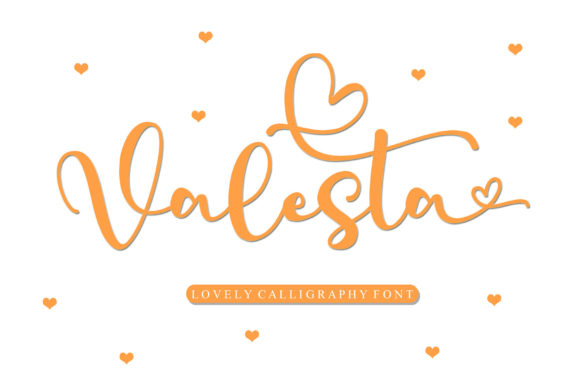
Valesta is a high-quality script font designed for designers and communicators who need typographic warmth without sacrificing polish. It’s not a novelty or trend-driven typeface—it’s built for sustained, thoughtful use across print and digital contexts where personality and professionalism must coexist. Its strength lies in its balance: it feels hand-drawn but remains legible, expressive but controlled, decorative but functional.
What Makes Valesta Stand Out Among Script Fonts
Many script fonts lean too far into either formality or informality—some feel stiff and over-engineered; others sacrifice clarity for flair. Valesta avoids both pitfalls. Its letterforms feature subtle variation in stroke weight, natural entry and exit strokes, and carefully calibrated spacing that supports readability at sizes as small as 14 pt in body text—unusual for a script. Unlike many handwritten-style fonts that rely on heavy alternates to mask repetition, Valesta’s base character set already carries quiet rhythm and organic flow.
The PUA (Private Use Area) encoding is a practical advantage—not just a technical footnote. It means swashes, ligatures, and stylistic alternates are accessible directly from standard keyboard layouts in design apps like Adobe Illustrator, Affinity Designer, or even modern versions of Canva. No need for glyph panels or complex OpenType feature toggling. For time-constrained professionals—freelancers juggling multiple clients, small business owners updating social graphics, or educators preparing classroom materials—this reduces friction without compromising creative control.
Real-World Performance Across Media and Use Cases
Valesta performs consistently well across applications where tone and texture matter. On wedding stationery, it conveys intimacy without cliché—its lowercase “g” and “y” have gentle descenders that echo traditional calligraphy, while the uppercase “S” and “Q” include graceful, unobtrusive flourishes. When used for business cards or boutique branding, it signals attention to detail rather than whimsy alone. A local florist, artisan bakery, or independent therapist might choose Valesta not to appear “artsy,” but to reflect care in communication—a nuance that resonates with discerning audiences.
In digital settings, Valesta holds up better than most scripts. While it’s not intended for long-form web copy, it works reliably in SVG or embedded font formats for hero banners, email headers, or social media visuals—especially when exported as vector or high-res raster. Its OpenType features include contextual alternates that automatically vary repeated characters (like consecutive “a”s or “e”s), reducing visual monotony in short headlines or taglines. That subtlety matters: readers subconsciously register repetition as artificial; Valesta avoids that impression.
Quality and Craftsmanship Behind the Design
Valesta was developed with typographic rigor—not just aesthetic intuition. Kerning pairs are extensively refined, particularly for common combinations like “To,” “The,” “Love,” and “With.” The lowercase “f” includes a clean, low-contrast crossbar that prevents collisions with following letters, and the “t” has a soft, tapered terminal instead of a sharp serif—enhancing continuity without sacrificing distinction. These details aren’t visible at first glance, but they affect how smoothly text reads and how confidently it scales.
File integrity is another quiet strength. The font ships with both OTF and TTF variants, tested across Windows, macOS, and recent Linux distributions. No rendering anomalies were observed in Adobe Creative Cloud apps, Figma (via variable font plugins), or browser-based editors using @font-face embedding. Glyph coverage includes Latin-1 and extended Latin characters—supporting accented characters used in French, Spanish, Portuguese, and German—making it viable for bilingual small businesses or international creatives.
Who Benefits Most—and When It Might Not Fit
Valesta serves creators whose work hinges on perceived authenticity and intentionality: wedding designers, boutique brand consultants, editorial art directors, indie publishers, and educators crafting presentation materials for adult learners. It’s especially effective when paired with a neutral sans-serif (e.g., Inter, Lato, or Montserrat) for hierarchy—Valesta for headings or accents, the sans for body copy. This pairing reinforces clarity while preserving voice.
It’s less suited for contexts requiring high-speed scanning or strict accessibility compliance. While it meets basic WCAG contrast guidelines at larger sizes, its connected forms and variable stroke widths reduce legibility for users with certain visual processing needs—so avoid using it for interface labels, legal disclaimers, or instructional step-by-step text. Similarly, if your brand voice prioritizes boldness, minimalism, or tech-forward clarity (e.g., SaaS dashboards, engineering firms, data visualization), Valesta’s warmth may misalign with audience expectations.
Practical Integration Tips
- Start simple: Use Valesta for single-line headlines or short quotes before expanding to multi-word logos. Test spacing manually—auto-kerning helps, but optical adjustments often improve impact.
- Leverage swashes selectively: One or two well-placed swashes (e.g., on the first and last letters of a phrase) add emphasis without overwhelming. Overuse dilutes effect and risks visual noise.
- Export smartly: For web use, convert to WOFF2 with subsetting if only using English characters—reducing file size by ~40% without loss of functionality.
- Test print fidelity: Run a physical proof at 100% scale on your target paper stock. Some swashes or fine terminals may soften on textured or uncoated paper—adjust tracking or size accordingly.
Long-Term Value and Workflow Fit
Valesta isn’t a one-off purchase—it’s an asset that integrates into repeatable workflows. Because it’s well-documented and widely compatible, it reduces the need to relearn tools or troubleshoot rendering issues across projects. Designers report reusing Valesta across client work for years—not because it’s trendy, but because it adapts: a slight change in color, size, or pairing shifts its tone from romantic to refined, from personal to premium.
For freelancers billing by project or hour, that consistency translates to efficiency. Once you understand Valesta’s rhythm and limits, you spend less time adjusting tracking or swapping fonts mid-design. For educators building reusable templates or marketers maintaining brand guidelines, its predictability supports scalability without dilution.
Valesta doesn’t promise transformation—it delivers reliability with grace. It won’t replace system fonts for UI or solve branding strategy gaps. But when the goal is to communicate sincerity, craftsmanship, or quiet confidence through typography, Valesta offers a rare combination: technical competence, aesthetic cohesion, and human resonance. Used with intention, it becomes part of the message—not just decoration around it.