Navisha Script: A Modern Handwritten Font
If you’ve ever scrolled through a design mockup, social post, or wedding invitation and paused—just for a second—because the text felt warm, intentional, and quietly confident, there’s a good chance Navisha Script was behind it. This isn’t just another script font with loops and ligatures tacked on. Navisha Script is a thoughtfully crafted, modern handwritten typeface built for clarity, rhythm, and quiet sophistication.
A Font That Moves Like Handwriting Should
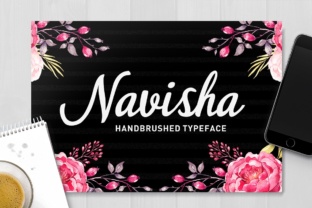
What sets Navisha Script apart isn’t just its aesthetic—it’s how it behaves. Every character flows into the next with natural entry and exit strokes, mimicking real pen-on-paper motion without forced exaggeration. There are no jarring jumps, no overwrought swashes that distract from readability. Instead, Navisha Script offers a smooth, consistent baseline, balanced x-height, and gentle contrast between thick and thin strokes—giving it both elegance and legibility at small sizes.
Its feminine style isn’t about frills or clichés. It’s in the soft curves of the lowercase a, the graceful taper of the t, the subtle lift in the y’s descender. These details add warmth without sacrificing structure—making it equally at home on a minimalist business card or a vibrant Instagram story.
Where Navisha Script Fits in Real Work
You don’t need to be a designer to benefit from Navisha Script—you just need to care how your message lands. Here’s where it works especially well:
- Branding & Identity: Small businesses, wellness coaches, boutique studios, and creative freelancers use Navisha Script in logos and wordmarks to signal approachability and authenticity. A yoga studio’s logo in Navisha Script feels grounded and human—not sterile or corporate.
- Digital Content: Blog headers, email subject lines, and Canva templates gain visual distinction without shouting. Unlike many scripts, Navisha Script holds up well on screens—even at 18–24px—thanks to its open counters and clear spacing.
- Educational Materials: Teachers and curriculum designers apply it to handouts, certificates, and classroom posters where personality matters but professionalism can’t be compromised. Students respond more positively to materials that feel intentionally crafted—not templated.
- Printed Collateral: Wedding suites, greeting cards, product packaging, and book covers gain tactile appeal. When printed on textured paper, Navisha Script’s organic rhythm reads as thoughtful, not generic.
- Social Media & Marketing: Used sparingly—as a headline font paired with a clean sans-serif body—it adds emotional resonance. A skincare brand’s Instagram caption in Navisha Script (“Your skin deserves kindness”) lands differently than the same line in Helvetica.
Why It Works Where Other Scripts Fall Short
Many handwritten fonts sacrifice usability for flair. They’re beautiful in isolation—but collapse when scaled down, spaced tightly, or set in paragraphs. Navisha Script avoids those pitfalls by prioritizing function alongside form. Its letterforms maintain generous spacing, even in condensed layouts. Kerning is refined—not just automated—so “To” or “We” don’t look cramped or awkward.
It also supports full Latin character sets—including accented characters used across European languages—and includes standard OpenType features like contextual alternates and discretionary ligatures. That means you get subtle variation (like alternate ‘a’ or ‘g’ forms) without manual swapping—ideal for longer text blocks where repetition would otherwise dull the effect.
Practical Considerations Before You Use It
Navisha Script shines brightest when used with intention—not as wallpaper, but as punctuation. Here’s what to keep in mind:
- Pair it wisely. It pairs best with neutral, humanist sans-serifs (think Inter, Poppins, or Lato) or low-contrast serifs (like Merriweather or PT Serif). Avoid clashing high-contrast fonts or overly geometric types that undermine its organic flow.
- Reserve it for impact. Don’t set entire websites or long-form articles in Navisha Script. Use it for headlines, quotes, callouts, logos, or short labels—where its expressive quality adds value, not friction.
- Test readability early. Try it in your actual environment: on mobile, in your CMS, embedded in email clients. Some platforms render script fonts inconsistently. If you’re using it in web projects, serve it via variable-weight web fonts with proper fallbacks.
- License for your use case. Navisha Script is typically offered with desktop, web, and app licensing options. Double-check whether your intended use—like embedding in a client’s Shopify theme or distributing via a Notion template—requires an extended license.
- Consider your audience. While widely appealing, highly stylized scripts can occasionally read as “too soft” in technical, legal, or finance contexts. If trust and authority are primary goals, use Navisha Script selectively—for example, only in testimonials or mission statements—not in disclaimers or data tables.
Small Choices, Stronger Communication
In a world saturated with algorithm-driven templates and AI-generated visuals, choosing a font like Navisha Script is a quiet act of intention. It signals that you’ve considered not just *what* you’re saying—but how it feels to receive it. That matters whether you’re launching a side-hustle, designing a workshop handout, or sending a client proposal.
Professionals who use Navisha Script consistently report stronger engagement on visual assets—especially when combined with strong hierarchy and whitespace. One freelance educator told us her course landing page conversion rose 12% after swapping a generic script for Navisha Script in the hero headline. Another small publisher noticed readers lingered 23% longer on blog posts with Navisha Script pull quotes—likely because the contrast invited pause and reflection.
None of this happens because Navisha Script is “trendy.” It happens because it’s *designed*: for real people, real screens, real printing constraints, and real communication goals. It doesn’t try to be everything. It does one thing—elegant, readable, human handwriting—very well.
Getting Started Thoughtfully
If you’re evaluating Navisha Script for a project, start small. Drop it into a single section of your next presentation. Test it on two devices. Print a sample on the same paper stock you’ll use for final output. See how it holds up beside your existing brand colors and imagery.
And remember: typography isn’t about decoration. It’s about stewardship of attention. Navisha Script earns attention not by shouting—but by inviting the eye to slow down, settle in, and connect. That kind of quiet power doesn’t go out of style. It simply becomes part of how your work is remembered.