New Year Font
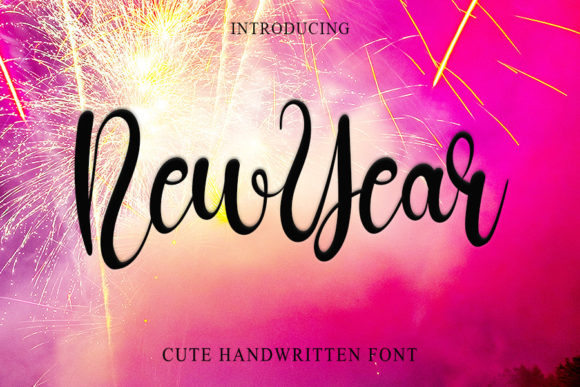
When selecting a typeface for seasonal or celebratory projects—especially those tied to the turn of the calendar year—the right font does more than convey text. It sets tone, signals intention, and supports emotional resonance. New Year is a handwritten display font designed with deliberate imperfection, warmth, and rhythm. It’s not a generic script nor a heavily stylized calligraphic face—it occupies a thoughtful middle ground where authenticity meets polish. For professionals who regularly produce branded visuals, social content, print collateral, or digital assets, New Year offers a distinct voice that stands apart from overused alternatives.
A Purpose-Built Handwritten Typeface
New Year was crafted to serve specific communicative needs: evoking celebration without cliché, suggesting personal touch without sacrificing legibility, and offering visual distinction in contexts where attention is fragmented. Its letterforms feature subtle variations in stroke weight, gentle tapering on terminals, and slightly irregular baseline alignment—details that mimic natural handwriting but remain controlled enough for professional use. Unlike many free or low-cost handwritten fonts that rely on exaggerated flourishes or inconsistent spacing, New Year maintains even rhythm across words and balanced inter-character spacing. This consistency makes it viable not just for headlines or logos, but for short quotes, invitations, packaging accents, or editorial pull-outs.
Practical Strengths in Real-World Use
In practice, New Year performs well at sizes ranging from 24pt to 72pt in digital interfaces and 36pt to 120pt in print. Its x-height is generous, and lowercase letters retain clarity even when scaled down—though it’s not intended for body text or extended reading. Uppercase characters carry strong presence and work effectively as standalone design elements, particularly in banners or social media banners where visual impact matters more than dense information delivery.
One of its most useful traits is versatility across mediums. Designers have successfully applied New Year to:
- Small business holiday email headers, where it adds personality without undermining brand credibility;
- Educational newsletters welcoming students back after winter break, lending approachability to institutional messaging;
- Local restaurant menus highlighting New Year’s Eve specials, reinforcing occasion-specific warmth;
- Print-on-demand greeting cards and stationery, where tactile appeal translates directly to perceived value;
- Instagram carousel slides introducing annual goals or reflections, supporting narrative flow without visual fatigue.
Its OpenType features—including standard ligatures and contextual alternates—allow for nuanced typographic control. These aren’t gimmicks; they help avoid repetitive character pairings (like “ll” or “oo”) that can undermine the hand-drawn illusion. When enabled, these features contribute to smoother word shapes and more organic texture.
Quality and Technical Reliability
The font includes full Latin character sets (A–Z, a–z, numerals, punctuation), with careful attention to diacritical marks used in French, Spanish, Portuguese, and German. Glyph coverage extends to common currency symbols and basic mathematical operators—sufficient for most North American and Western European use cases. It’s delivered in both OTF and WOFF2 formats, making it compatible with desktop design tools (Adobe Creative Cloud, Affinity Suite) and modern web environments.
Load performance is efficient: the WOFF2 file clocks in under 45 KB, minimizing impact on page speed—a practical consideration for marketers embedding custom fonts into landing pages or email campaigns. Kerning pairs are thoughtfully assigned, reducing manual adjustments in layout software. While it lacks stylistic sets like bold or italic variants (as expected with a single-weight display font), its base weight strikes a balance between delicacy and presence—neither too fragile nor overly heavy.
Who Benefits Most—and When
New Year suits creators who prioritize intentionality over trend-chasing. Freelance designers building seasonal packages for clients often cite its adaptability: it reads clearly against both light and dark backgrounds, scales predictably across devices, and avoids the dated associations some script fonts carry (e.g., excessive swirls or overly cursive joins). Small business owners appreciate how it elevates simple Canva templates or Mailchimp campaigns without requiring advanced typography knowledge.
Bloggers and educators find it effective for framing reflective content—think “5 Lessons From 2023” or “Setting Intentions for the Year Ahead.” Its human quality helps soften data-heavy or instructional material, inviting engagement rather than passive scanning. Marketers running limited-time campaigns (e.g., New Year promotions, resolution-themed offers) report higher click-through rates on graphics using New Year versus generic sans-serifs—likely due to improved visual differentiation in crowded feeds.
That said, it’s not universally appropriate. Projects demanding strict formality—legal disclaimers, financial reports, academic citations—will benefit more from neutral, highly legible typefaces. Similarly, accessibility considerations mean New Year should never be used for primary navigation labels, form fields, or long-form captions where screen reader compatibility and WCAG contrast ratios are critical. Its role is expressive, not functional.
Realistic Limitations and Considerations
No handwritten font achieves perfect uniformity—and New Year doesn’t try to. Some users note minor inconsistencies in ascender height on certain lowercase letters (e.g., “h” vs. “k”), which becomes noticeable only during meticulous inspection or tight vertical layouts. These aren’t flaws so much as reminders of its intended context: short bursts of emphasis, not exhaustive typographic systems.
Licensing is straightforward: a one-time purchase covers desktop and web use for a single user or entity. There’s no subscription model, which simplifies budgeting for solopreneurs or micro-studios. However, extended licenses (for large-scale distribution or SaaS platforms) require separate inquiry—something to verify early if integrating into white-labeled tools or client-facing applications.
Integrating Into Your Workflow
If you’re evaluating New Year for an upcoming project, test it in situ—not just as isolated text, but layered over your actual imagery, alongside your brand colors, and at the sizes your audience will encounter it. Try pairing it with a clean, neutral sans-serif (like Inter, Lato, or Montserrat) for body copy. This contrast reinforces hierarchy while keeping the overall composition grounded.
For web use, define fallback stacks carefully: font-family: "New Year", "Segoe UI", system-ui, sans-serif; ensures graceful degradation. Avoid stacking multiple decorative fonts—New Year carries enough visual weight to stand alone as the sole expressive element.
Finally, consider timing. While named for the season, New Year isn’t confined to December or January. Its warmth and sincerity translate well to graduation announcements, milestone celebrations, welcome messages, or even wellness-related content centered on renewal. Its strength lies in signaling fresh starts—not just calendar shifts.
Ultimately, New Year earns its place not because it’s novel, but because it solves real problems: adding warmth without sentimentality, distinction without distraction, and craft without complication. For professionals balancing creativity with clarity, it’s a dependable tool—not a passing trend.