Cleany: A Handwritten Font for Authentic Chalkboard-Style Design
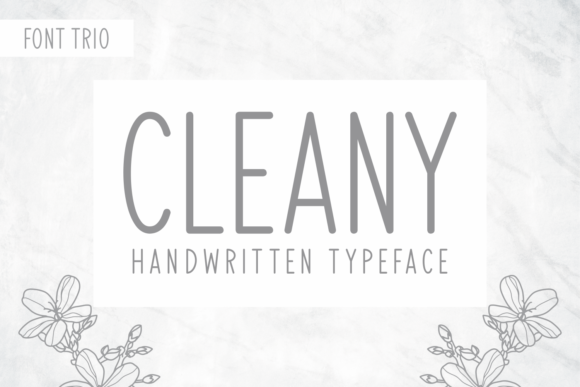
Cleany is a handwritten font designed to mimic the natural, slightly imperfect rhythm of chalk on a slate surface. It’s not overly ornate or stylized—instead, Cleany offers clean letterforms with subtle variation in stroke weight, slight baseline wobble, and gentle spacing that avoids mechanical uniformity. This gives it an approachable, human quality without sacrificing legibility. Its charm lies in restraint: no excessive flourishes, no forced quirkiness, just quiet authenticity. That makes Cleany especially effective when realism matters—like simulating hand-lettered classroom posters, artisanal café menus, or heartfelt quote graphics meant to feel personal rather than polished.
What Sets Cleany Apart From Other Handwritten Fonts
Many handwritten fonts fall into one of two categories: highly decorative scripts (with dramatic swashes and variable connections) or ultra-minimalist “dry-erase” fonts that lean too far into digital sterility. Cleany occupies a middle ground. It’s lettered—not calligraphic—so each character stands independently, making it more versatile for short phrases, labels, or bullet points where connected scripts would break readability. Unlike some chalk-style fonts that overemphasize texture (gritty noise, heavy grain, or simulated smudging), Cleany keeps texture subtle. The focus stays on form and flow, not visual distraction.
This balance supports clarity at smaller sizes—something many expressive handwritten fonts struggle with. At 24–36 pt, Cleany reads comfortably on printed handouts or digital slides. At 60+ pt, it holds presence on banners or social media graphics without looking cramped or cluttered. Its lowercase “a,” “g,” and “y” include open, friendly shapes that avoid ambiguity—important when designing for diverse audiences, including younger learners or readers with dyslexia-friendly preferences.
Where Cleany Fits in Real-World Teaching and Learning Contexts
In educational design, tone and accessibility matter as much as aesthetics. Cleany’s warmth supports inclusive communication: it feels inviting but not childish, intentional but not rigid. Teachers using Cleany for vocabulary cards, classroom rules posters, or student-facing slide headers often report that learners perceive the material as more approachable—likely because the font mirrors how many educators actually write on whiteboards or chart paper.
For example, a science teacher creating a “Lab Safety Checklist” might use Cleany for the main headings (“Wear Goggles,” “Tie Back Hair”) while pairing it with a neutral sans-serif (like Open Sans or Inter) for explanatory subtext. That contrast reinforces hierarchy without competing visually. Similarly, early childhood educators find Cleany works well for name tags, emotion charts, or daily schedule boards—its consistency across characters helps emerging readers recognize letter shapes, while its soft edges reduce visual fatigue.
Strengths You Can Rely On
- Legibility at multiple sizes: Works clearly from 18 pt (handouts) up to 96 pt (projector slides).
- Low visual noise: No heavy textures or simulated chalk dust that degrade when scaled or printed.
- Open licensing options: Available in versions suitable for commercial classroom materials, school websites, and non-profit educational tools.
- Consistent rhythm: Letters align naturally on the baseline without awkward gaps or crowding—reducing the need for manual kerning in most cases.
Tradeoffs to Keep in Mind
Cleany isn’t built for every use. Because it prioritizes authenticity over versatility, it lacks extended language support beyond basic Latin characters—so it’s not ideal for multilingual classrooms requiring accented characters, Cyrillic, or Greek. It also doesn’t include stylistic alternates (like swash capitals or contextual ligatures), which limits expressive range for branding projects needing tonal flexibility.
Its simplicity becomes a limitation when high contrast or strong visual impact is required. For instance, a bold poster demanding immediate attention—like an emergency procedure sign in a lab—may benefit more from a heavier, bolder font with tighter spacing and stronger weight contrast. Cleany excels in calm, thoughtful contexts—not urgent or high-energy ones.
Also, while Cleany mimics handwriting, it doesn’t simulate the variability of actual human writing. If your goal is to replicate a specific person’s handwriting (e.g., a teacher’s notes or a child’s journal entry), you’d need a custom solution—or a different font family designed for that purpose. Cleany offers consistency first, individuality second.
Comparing Cleany With Common Alternatives
When evaluating handwritten fonts, designers often consider three broad categories: chalkboard-style, script-based, and minimalist handwritten. Cleany belongs firmly in the first group—but with notable differences from peers.
Some chalkboard fonts exaggerate texture to the point where fine detail disappears when printed or viewed on low-resolution screens. Cleany avoids this by embedding subtle irregularity in structure—not surface noise. Others rely on tight letter spacing to suggest density, which can make words harder to parse quickly. Cleany uses generous, consistent spacing that supports scanning and comprehension.
Compared to script fonts (like those used for wedding invitations or luxury branding), Cleany trades elegance for utility. Script fonts often require careful line-length management and may break unpredictably across devices. Cleany flows predictably, behaves reliably in responsive layouts, and remains readable even when exported as static PNGs for social media.
Against minimalist handwritten options—often built from geometric shapes or uniform strokes—Cleany feels more grounded and tactile. Those minimalist fonts can read as sterile or AI-generated; Cleany retains a quiet humanity that resonates in learning environments where trust and connection matter.
When Cleany Is Likely the Right Choice
Cleany fits best when your priority is clarity with character. Consider it if you’re designing:
- Classroom posters and anchor charts where students need to read and internalize information quickly;
- Digital teaching resources—Google Slides, Canva templates, or LMS banners—that must remain legible across devices;
- Printed materials like worksheets, flashcards, or take-home packets where visual fatigue is a concern;
- Branding for small educational businesses (tutoring services, Montessori studios, homeschool co-ops) seeking warmth without whimsy.
It also pairs well with widely available system fonts (like Roboto, Lato, or Noto Sans), making implementation straightforward—no need for complex webfont loading strategies or fallback concerns.
When You Might Choose Something Else
If your project requires extensive multilingual support, advanced OpenType features (like automatic fractions or stylistic sets), or needs to scale dramatically—from tiny app icons to large wall murals—Cleany may not be sufficient on its own. In those cases, a more robust font family with expanded weights and language coverage could serve better.
Similarly, if your design goals center on high-energy engagement—think after-school program flyers, youth event banners, or interactive game interfaces—you may want a bolder, more dynamic option. Cleany’s strength is its quiet confidence, not its volume.
And while Cleany works beautifully for quotes and short statements, longer blocks of body text (more than two or three lines) are better handled with a highly legible serif or sans-serif. Its charm is strongest in focused, intentional applications—not extended reading.
Ultimately, choosing Cleany isn’t about finding the “best” font—it’s about matching tool to intention. When authenticity, clarity, and approachability converge in a single typeface, Cleany delivers quietly and consistently. It won’t shout, but it will be understood—and remembered.