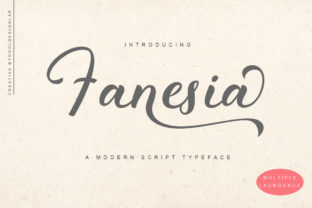
Fanesia: Elegant Handwritten Typography, Thoughtfully Crafted
Imagine opening a wedding invitation that feels personal—not just printed, but penned with intention. Or launching a boutique skincare brand where every label whispers craftsmanship before the customer even touches the bottle. That subtle resonance? It often begins with typography. And for designers, founders, and creators who value authenticity without sacrificing polish, Fanesia offers something rare: a handwritten script grounded in classical calligraphy, yet versatile enough for modern digital workflows.
More Than Just “Pretty Letters” — A Font Built for Meaningful Expression
Fanesia isn’t a digitized imitation of handwriting—it’s a carefully considered interpretation. Its roots trace back to formal copperplate and Spencerian traditions, but its execution is contemporary: balanced spacing, graceful entry and exit strokes, and intentional variation in weight and rhythm. With over 400 handmade glyphs—including ligatures, swashes, stylistic alternates, and multilingual support—Fanesia gives you expressive control, not just decoration. Each character was drawn by hand, then meticulously refined for screen and print consistency.
This level of craft matters when tone is non-negotiable. A tech startup pitching to educators might use Fanesia for keynote slide headers—not to appear “artsy,” but to signal warmth, approachability, and human-centered thinking. A freelance illustrator might pair it with clean sans-serifs in a portfolio site to highlight contrast: precision meets personality.
Where Fanesia Adds Quiet Impact (Without Overpowering)
Unlike many script fonts that demand attention—or worse, distract from content—Fanesia works *with* your message. Its elegance is understated, not theatrical. That makes it unusually adaptable:
- Branding & Packaging: Small-batch coffee roasters, ceramic studios, or letterpress printers use Fanesia on labels and business cards to reinforce artisanal values—without needing custom illustration.
- Digital Communication: Bloggers embedding pull quotes in long-form articles find Fanesia improves visual pacing and emotional emphasis—especially in lifestyle, education, or wellness niches.
- Printed Materials: Educators designing classroom posters or curriculum handouts report higher student engagement when key concepts appear in Fanesia—its organic flow supports memory retention better than rigid, uniform scripts.
- Invitations & Announcements: Wedding designers appreciate how Fanesia scales beautifully across formats—from laser-cut acrylic place cards to PDF save-the-dates—thanks to its robust OpenType features and consistent x-height.
Why 237 Alternate Characters Matter More Than You Might Think
It’s not about having options for option’s sake. Those 237 alternates solve real problems. Repetition weakens visual trust—seeing the same “a” or “t” three times in one word can look mechanical, not handwritten. Fanesia’s alternates let you vary letterforms naturally, mimicking how a person actually writes. Designers using Adobe Illustrator or Affinity Designer can access these via glyph panels or contextual alternates—no manual swapping required.
For example: When setting a monogram for a luxury candle brand, switching between two distinct “L” forms prevents symmetry fatigue. Or when typesetting a poem title, rotating between three versions of the capital “S” creates subtle rhythm—like breath between lines.
Who Benefits Most—and When to Pause and Consider Alternatives
Fanesia shines for professionals who prioritize clarity of voice alongside aesthetic cohesion. Freelance designers building brand identities for service-based businesses (therapists, financial advisors, yoga studios) find it bridges professionalism and empathy. Small business owners managing their own marketing often choose Fanesia because it elevates DIY materials without requiring advanced design skills—especially when used sparingly and intentionally.
That said, Fanesia isn’t universal. It’s not ideal for dense body text—its decorative nature slows reading at small sizes. If your project demands legibility above all (think safety signage, medical instructions, or accessibility-first web interfaces), a highly legible sans-serif remains the responsible choice. Similarly, if your brand voice leans toward bold minimalism or industrial grit, Fanesia’s lyrical quality may feel misaligned—no font should override authentic positioning.
Also worth noting: While Fanesia includes extensive Latin-based language support, users working with Arabic, Devanagari, or complex CJK layouts will need complementary typefaces. It’s a specialist tool—not an all-in-one solution.
Practical Tips for Getting Started—Without Overcomplicating
You don’t need a design degree to use Fanesia well. Start simple:
- Use it for hierarchy, not volume. Apply it only to headlines, logos, or short quotes—never full paragraphs.
- Pair deliberately. Contrast is key. Try Fanesia with neutral, well-spaced sans-serifs like Inter, Lato, or Source Sans Pro. Avoid other scripts or overly decorative fonts—they compete instead of complement.
- Test at real size. What looks elegant at 48pt on screen may blur at 14pt on mobile. Always preview in context: email clients, Instagram story templates, or printed mockups.
- Leverage OpenType features—but don’t force them. Enable contextual alternates first. Only add swashes or flourishes where they enhance meaning (e.g., a single elegant “&” in a logo lockup).
A Tool That Supports Intention—Not Just Aesthetics
In a world saturated with generic templates and AI-generated visuals, choosing a font like Fanesia signals care. Not just in how something looks—but in how it’s meant to be received. A therapist’s website using Fanesia for session descriptions doesn’t shout “I’m creative!”—it quietly says, “I honor the nuance in your story.” A nonprofit using it for donor thank-you letters adds warmth without sentimentality. That subtlety is hard to replicate—and harder to ignore.
What makes Fanesia enduring isn’t its ornamentation, but its restraint. Its classical roots give it authority; its handmade details give it soul. And because it’s built with real-world use in mind—not just visual novelty—it integrates smoothly into existing tools and workflows. No plugins. No steep learning curves. Just thoughtful typography, ready when you are.
If your work involves communicating value, building trust, or inviting connection—even in small moments—Fanesia offers more than style. It offers alignment: between what you say, how you say it, and why it matters.