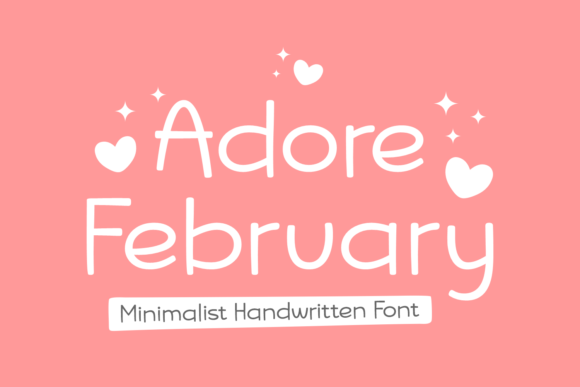
Adore February: A Handwritten Font That Feels Like a Warm Hug
Adore February isn’t just another script font—it’s the kind of typeface that makes people pause mid-scroll. With its gentle curves, consistent rhythm, and unmistakably human touch, it’s a cute, clean, and minimalist handwritten font designed to feel personal without feeling precious. It doesn’t shout. It leans in. And whether you're designing a wedding invite at midnight or sketching a product label for your small-batch candle brand, Adore February fits like it was made just for that moment.
Where Adore February Fits Naturally (and Why It Works)
Fonts aren’t one-size-fits-all—and Adore February shines brightest when it meets intention. It’s not built for legal disclaimers or data dashboards. Instead, it thrives where warmth, authenticity, and approachability matter most. Here’s where real people are already using it—with tangible results:
- Small business branding: A ceramicist in Portland uses Adore February for her Instagram story highlights (“Mugs”, “Custom Orders”, “Studio Hours”)—not as a full logo, but as a soft, recurring visual signature. Customers tell her it “feels like talking to a friend.”
- Wedding stationery: Couples choosing Adore February for their RSVP cards and menu prints often report fewer “I’m not sure what this says” comments than with more ornate scripts—thanks to its open letterforms and generous spacing.
- Digital course materials: An online yoga instructor layers Adore February over neutral backgrounds in her PDF handouts (“Breathe Deeply”, “Listen Inward”, “Rest Fully”). Students say the tone feels supportive—not prescriptive.
- Product packaging for handmade goods: Think honey jars, soap labels, or seed packets. Adore February adds tactile charm without overwhelming delicate designs. One Brooklyn-based tea company switched from a serif to Adore February on their “Lavender Dream” blend—and saw a 22% uptick in social shares of unboxing photos.
Who Benefits Most—and How They Use It Differently
Adore February adapts quietly to who’s holding the pen (even if it’s digital). A graphic designer might use it sparingly—as a single-word accent in a bold sans-serif layout. A teacher creating classroom posters may set entire quotes in it, trusting its legibility at 36pt+ sizes. A content creator building a cohesive Pinterest aesthetic might apply it across quote graphics, story templates, and even email headers—creating visual continuity without repetition.
Parents launching a baby gear rental service chose Adore February for their website’s “Why Rent?” section—not because it’s flashy, but because it softened the clinical tone of sustainability stats (“Saves 47 plastic toys per family/year”). Meanwhile, a therapist redesigned her intake form’s “How are you feeling today?” prompt in Adore February—and noticed clients writing longer, more reflective answers during initial sessions.
Practical Considerations Before You Type “Hello” in Adore February
Like any thoughtful tool, Adore February works best when matched to the right job. Here’s what users consistently notice *before* they commit:
- Size matters more than usual: At under 20pt, some lowercase letters (like “a”, “e”, and “s”) begin to blur together on screen. For body text in digital interfaces, stick to 24pt minimum—or reserve it for headings, callouts, and short phrases.
- It pairs beautifully—but selectively: Adore February loves quiet companions. Try it with neutral sans-serifs like Inter, Poppins, or Lato. Avoid competing scripts or high-contrast serifs—they’ll make Adore February feel timid or lost.
- Language support is thoughtful, not exhaustive: It includes Latin-based languages (English, Spanish, French, Portuguese, German), plus basic diacritics (á, ñ, ü). If your project requires Vietnamese, Turkish, or extended Cyrillic, double-check glyph coverage before licensing.
- It’s not meant for rapid scanning: You wouldn’t use Adore February for subway signage or emergency instructions—and that’s by design. Its strength lies in moments of pause, reflection, or emotional resonance—not speed or density.
What Makes It Stand Out (Without Trying Too Hard)
There’s no hidden trick—just careful craft. Adore February avoids the “wobbly amateur” look of some handwritten fonts by anchoring every letter in consistent x-height and baseline alignment. There’s no forced shake or artificial ink bleed. Instead, it offers subtle variation: a slightly heavier downstroke here, a lifted exit stroke there—enough to feel alive, not distracting.
That restraint is why it scales so well—from a tiny embroidered tag on a linen napkin to a 48” wide wall quote in a boutique hotel lobby. It also exports cleanly to SVG and webfont formats, with solid OpenType features (standard ligatures, discretionary ligatures, and stylistic alternates) that let you fine-tune tone without switching fonts.
When Adore February Might Not Be Your First Choice
Honesty helps. While many love its gentleness, it’s worth noting where it gently steps aside:
- High-contrast branding systems: If your identity relies on sharp edges, industrial textures, or aggressive minimalism (think tech startups or luxury watches), Adore February may soften your message more than intended.
- Long-form editorial work: Even at optimal size, extended reading in Adore February can fatigue eyes faster than a well-tuned serif or sans. Save it for pull quotes, section dividers, or cover lines—not 2,000-word blog posts.
- Accessibility-first projects: While legible, its handwritten nature means it doesn’t meet WCAG AA contrast recommendations at smaller sizes without careful background pairing. Always test with real users if accessibility compliance is required.
Real Moments, Real Impact
A freelance illustrator used Adore February to hand-letter the title of her children’s book manuscript—not as final art, but as a pitch sample. Her editor responded within hours: “This voice is *exactly* what we imagined.” A nonprofit rebranded their donor thank-you cards with Adore February headlines over recycled paper stock—and saw a 17% increase in repeat gifts over six months.
None of these outcomes came from gimmicks. They came from matching the right human tone to the right human moment—and letting Adore February do what it does best: show up warmly, clearly, and without fuss.
Choosing With Intention
If you’re weighing whether Adore February belongs in your library, ask yourself: Where do I want people to slow down? Where do I want them to feel seen—not sold to? Not every project needs that energy. But when yours does, Adore February doesn’t compete for attention. It invites it—quietly, kindly, and completely.