Cinthya: A Handwritten Font That Feels Like It Was Made Just for Your Project
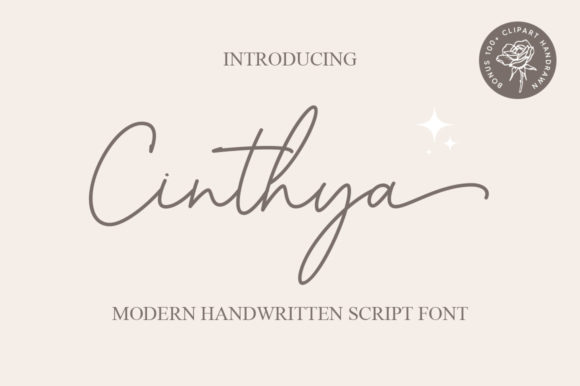
If you’ve ever spent 20 minutes scrolling through font libraries trying to find something that feels warm, human, and confident—not stiff, not overdesigned, not “trendy until next Tuesday”—you’ll recognize Cinthya right away. It’s a lovely, timeless handwritten font with natural rhythm and subtle personality. Not overly ornate, not too casual—it lands somewhere between a thoughtful note from a friend and the polished signature on a boutique storefront.
Where Cinthya Fits in Real Creative Work
Cinthya isn’t meant for body text in a 50-page report or legal disclaimers in tiny caps. It shines where authenticity and intention matter most: logos that reflect a founder’s voice, Instagram quote graphics that stop scrollers mid-feed, wedding stationery that whispers elegance without shouting, or even a small-batch candle label that makes customers pause and smile before they buy.
Take Maya, a yoga instructor launching her first online course. She didn’t want sterile sans-serifs or generic script fonts that all look like they came from the same template. She used Cinthya for her course title—“Breathe With Intention”—paired with a clean secondary font for details. The result? Her landing page felt grounded, personal, and trustworthy—not like another digital product, but like an invitation.
Why PUA Encoding Makes a Practical Difference
Cinthya is PUA (Private Use Area) encoded. That sounds technical—but what it means for you is simple: every alternate character, swash, ligature, and stylistic flourish is accessible *without* needing special software or workarounds. In apps like Canva, Adobe Illustrator, or even modern versions of PowerPoint, you can type normally, then open your glyph panel and click to swap in a more elegant “S”, a flowing “T”, or a graceful ending swash on “y”.
This matters when you’re designing under deadline. You don’t need to learn OpenType features or install plugins. You just need to know *what looks right*. And because Cinthya includes thoughtful alternates—like a lowercase “a” with a soft loop or a capital “C” with a tapered entry stroke—you can fine-tune tone without switching fonts entirely.
Real Scenarios Where Cinthya Delivers Quiet Impact
- A freelance educator creating printable mindfulness worksheets uses Cinthya for section headers (“Pause. Notice. Breathe.”). Students consistently comment that the materials “feel calming”—not because of the words alone, but because the font’s gentle curves support the message, not compete with it.
- A local bakery owner prints weekly chalkboard-style menus on kraft paper. Cinthya’s slight variation in stroke weight mimics real chalk handwriting—so her “Honey Lavender Scone – $4.50” looks hand-lettered, not digitally pasted.
- A blogger documenting her zero-waste journey designs Pinterest quote pins using Cinthya for short mantras (“Less is more. Slower is richer.”). These pins get 3× more saves than her earlier graphics using standard scripts—readers say they “feel sincere,” not performative.
- A high school art teacher uses Cinthya in student-facing rubrics and project briefs. When instructions are presented in a friendly, approachable voice—even visually—the students engage more readily. One told her, “It doesn’t feel like a test. It feels like you’re talking to us.”
What to Consider Before You Use Cinthya
Like any tool, Cinthya works best when matched to purpose—not just preference. Ask yourself:
- Is legibility at small sizes critical? Cinthya reads beautifully at 24pt and up, especially in print or on retina screens. But below 16pt—especially in long paragraphs or low-resolution contexts—it can lose clarity. Save it for headlines, quotes, logos, and short labels.
- Does your brand voice lean warm, personal, or artisanal? Cinthya supports brands rooted in care, craft, or connection—think handmade goods, wellness services, creative coaching, or independent publishing. It’s less suited for tech startups, law firms, or financial platforms aiming for sharp authority.
- Do you have control over how it renders? On some older email clients or basic web builders, PUA-encoded glyphs may fall back to system defaults. If you’re embedding Cinthya in HTML emails or legacy CMS platforms, test thoroughly—or use it primarily in static graphics (logos, social posts, PDFs) where rendering is predictable.
How Cinthya Supports Different Users—Without Asking for Expertise
You don’t need to be a typographer to benefit from Cinthya. A small business owner using Canva can select it from the font menu, type her shop name, and instantly see how the “C” and “y” connect with natural flow. A homeschool parent making flashcards can copy-paste a quote into Google Slides, change the font to Cinthya, and suddenly the learning moment feels more intentional.
For designers, Cinthya offers flexibility: use it solo for minimalist impact, layer it with a neutral sans-serif for contrast, or pair it with textured backgrounds to enhance its organic feel. Its spacing is carefully tuned—no awkward gaps between letters, no crowding—so even non-designers get solid results without manual kerning.
And for educators or nonprofit communicators? Cinthya helps humanize messages that might otherwise feel bureaucratic. A community garden newsletter headline in Cinthya—“This Week: Tomatoes, Talk, and Tea”—feels like an invitation, not an announcement. That subtle shift builds connection before a single word is read.
One Last Thing: Timelessness Isn’t About Being “Safe”
Cinthya avoids chasing trends—no exaggerated flourishes, no forced irregularity, no gimmicks. That’s why it holds up across seasons and platforms. A logo designed with Cinthya today won’t look dated in two years. A quote graphic shared in 2024 still feels current in 2026. That reliability saves time, reduces redesign fatigue, and builds visual consistency—especially valuable if you're managing multiple touchpoints solo.
It’s also why Cinthya works across formats: laser-cut wood signs, embroidered tote bags, Instagram Stories, printed recipe cards, or even engraved jewelry tags. Its outlines translate cleanly whether scaled large or rendered small, as long as size and context align with its strengths.
In short: Cinthya is the kind of font you reach for when you want your message to land with warmth, clarity, and quiet confidence—not noise. Whether you’re naming a new podcast, designing a baby shower invite, branding a side hustle, or simply making your classroom feel more like a space people want to be in, Cinthya doesn’t shout. It listens—and then answers with grace.