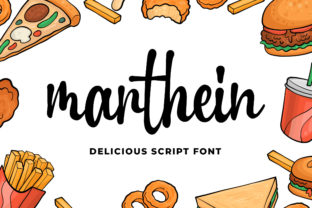
Marthein: A Playful, Delicious Handwritten Font That Feels Like a Smile in Type
Imagine opening a bakery website and seeing the words “Freshly Baked Daily” rendered not in crisp sans-serif, but in warm, bouncy, slightly uneven letters—each one with its own personality, like it was drawn by a friendly baker with flour on their apron. That’s the magic of Marthein. It’s not just another handwritten font—it’s a joyful, expressive typeface that balances playfulness with readability, charm with clarity.
What Makes Marthein Stand Out in a Sea of Script Fonts?
There are hundreds of handwritten fonts online. Many lean too far into whimsy—hard to read at small sizes or awkward in formal contexts. Others sacrifice character for consistency, ending up sterile and forgettable. Marthein avoids both traps.
Its design features gentle, rounded strokes with subtle variations in weight—thicker downstrokes, lighter upstrokes—mimicking natural pen pressure. The lowercase ‘a’, ‘g’, and ‘y’ have soft, open counters; the ‘s’ has a smooth, looping rhythm; and the ‘t’ includes a charming little crossbar tilt that feels intentional, not accidental. These aren’t quirks—they’re carefully considered details that give Marthein authenticity without sacrificing legibility.
Unlike many script fonts that force connected letters (requiring OpenType ligatures or manual kerning), Marthein works beautifully as both connected and unconnected. That flexibility makes it practical—not just pretty. You can use it for a hand-lettered logo, then switch seamlessly to clean, spaced-out subheadings or body text in its companion sans-serif (if available) or even pair it thoughtfully with a neutral serif like Merriweather or Lora.
Where Marthein Shines: Real-World Uses That Just *Work*
You don’t need a branding degree to know when a font feels right—and Marthein lands intuitively across several high-impact use cases:
- Craft brands and indie product packaging—Think artisanal honey labels, ceramic studio tags, or small-batch candle boxes. Marthein adds warmth and human scale, helping customers feel like they’re buying from a person, not a corporation.
- Food & beverage websites and menus—Its “delicious” quality isn’t marketing fluff. Rounded forms evoke sweetness, softness, comfort. Pair it with warm background tones and food photography, and you’ve got instant emotional resonance.
- Children’s book illustrations and educational materials—Not childish, but approachable. Teachers and illustrators use Marthein for storybook titles, classroom posters, and activity sheets because it feels inviting—not intimidating—to young readers.
- Personal blogs, wedding stationery, and creative portfolios—It carries personality without shouting. A photographer might use Marthein for their site’s tagline (“Seeing the world, one frame at a time”), letting the font quietly reinforce their thoughtful, human-centered perspective.
Importantly, Marthein scales well. At 36px, it sings in hero sections. At 18px, it remains legible in callout boxes or testimonial quotes. And with proper line-height and letter-spacing adjustments, it holds up even at 14px for short UI elements—like “Subscribe” buttons or email opt-in headers—where friendliness matters more than formality.
Pairing Marthein Thoughtfully: Less Is More
Handwritten fonts can overwhelm if overused—or worse, clash. The key with Marthein is contrast through simplicity.
Try pairing it with clean, geometric sans-serifs like Inter, Manrope, or Montserrat. Their precision highlights Marthein’s organic flow. Avoid other scripts or overly decorative fonts—they compete instead of complement. If your project calls for elegance rather than energy, consider a low-contrast serif like Cormorant Garamond or Playfair Display for body copy while keeping Marthein reserved for headings and accents.
Color matters too. Marthein thrives in warm, natural palettes—terracotta, oat, sage, cream—but also surprises in deep navy or charcoal when set against light backgrounds. Steer clear of neon or high-saturation hues unless irony or youthfulness is the explicit goal. Its strength lies in sincerity, not flash.
Technical Considerations Before You Download Marthein
Before dropping Marthein into your next project, check three practical things:
- Licensing: Is it free for commercial use? Some versions of Marthein are free for personal projects only. Always verify the license—especially if you’re designing for a client or selling physical goods. Reputable sources like Google Fonts (if available), Creative Market, or the designer’s official site will clarify usage rights upfront.
- File formats: Does it include web-optimized WOFF2 files? For websites, lightweight, modern formats ensure fast loading—critical for SEO and Core Web Vitals. If you only get .OTF or .TTF, you’ll need to convert or host responsibly.
- Language support: Does Marthein cover accented characters (like é, ñ, ü) or extended Latin glyphs? If your audience includes Spanish, French, or Vietnamese speakers, missing diacritics break trust—and accessibility. Check the character map before committing.
Also worth noting: Marthein doesn’t include extensive stylistic sets (no swashes, no alternate glyphs out of the box). That’s intentional. Its power is in restraint—not ornamentation. If your brand needs heavy embellishment, this isn’t the font. But if you value clarity, warmth, and quiet confidence? Marthein delivers without overreaching.
Why Designers Keep Coming Back to Marthein
It’s rare for a font to feel both timeless and timely—but Marthein does. In an era where users scroll past content in under two seconds, typefaces that communicate tone instantly have real strategic value. Marthein signals approachability before a single word is read. It says, “We’re here to connect—not impress.”
That’s why it appears on everything from Shopify store banners to nonprofit campaign emails, from Instagram story templates to printed workshop handouts. It doesn’t demand attention—it earns it, gently.
And unlike trend-driven fonts that feel dated within a year, Marthein avoids gimmicks. No exaggerated bounce, no forced irregularity, no forced “grunge.” Its imperfections are soft, human, and consistent—like handwriting should be.
A Word on Accessibility and Inclusivity
Legibility isn’t just about aesthetics—it’s ethical. While Marthein is highly readable for most users, avoid using it for long-form body text, legal disclaimers, or interface labels where precision is non-negotiable. Reserve it for headlines, quotes, CTAs, and visual accents—places where tone supports meaning.
If you’re designing for neurodiverse audiences or users with dyslexia, pair Marthein with dyslexia-friendly fonts (like Open Dyslexic or Hanken Grotesk) for supporting text. Never rely solely on decorative type for critical information. Good typography serves everyone—not just those who love beautiful letters.
Getting Started With Marthein: A Quick Practical Tip
Don’t overthink the first use. Try this: Open your design tool, type “Hello” in Marthein at 48px. Adjust tracking to +20–+40 (depending on weight), add 1.4 line-height, and place it over a soft photo background. Instant warmth. Instant recognition. That’s the Marthein effect—immediate, intuitive, and deeply human.
From there, let the voice of your project guide you. Is it joyful? Lean into its bounce. Is it tender? Emphasize its curves. Is it grounded? Use it sparingly—just enough to whisper, not shout.
Because at its core, Marthein isn’t about rules. It’s about resonance. And when type resonates, everything else—the message, the emotion, the connection—falls beautifully into place.