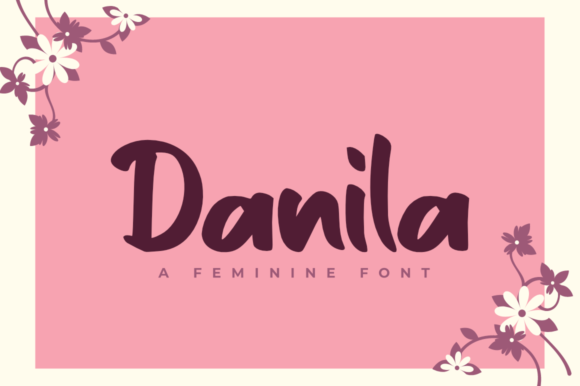
Danila: A Handwritten Font That Feels Human in a Digital World
In an era where interfaces grow sleeker, algorithms personalize faster, and content scrolls endlessly, something quietly powerful is gaining ground: authenticity. Not as a marketing buzzword—but as a tangible quality people respond to instinctively. Danila embodies that shift. It’s not a font designed for dominance or technical precision. It’s a simple and flowing handwritten font—warm, unforced, and rhythmically uneven in just the right way. Its strokes breathe. Its curves invite. And because it avoids rigid uniformity, it signals presence—not automation.
Why Handwriting Still Resonates—Even on Screens
We don’t read handwriting the same way we read system fonts. Our brains process handwritten text with subtle emotional cues: the slight tilt of a letter, the variation in line weight, the pause implied by a lifted pen. Danila captures those micro-expressions without requiring actual pen-on-paper. That matters more than ever now. As AI-generated visuals and templated layouts become commonplace—even expected—designers, educators, and small business owners are noticing how quickly generic aesthetics blur together. A newsletter using Danila doesn’t just stand out; it subtly signals care, intention, and individual voice.
This isn’t nostalgia for analog tools. It’s responsiveness to how attention works today. Studies in visual cognition show that moderate visual irregularity—like the gentle inconsistency in Danila’s lowercase a or g—increases retention and perceived trustworthiness when used contextually. Think of a handmade soap label, a workshop flyer, or a personal blog header: Danila doesn’t shout. It leans in.
From Niche to Necessary: How Creative Workflows Are Changing
Five years ago, many professionals treated typography as a “set-and-forget” layer—pick a clean sans-serif, align everything, move on. Today, workflows are more iterative, collaborative, and audience-aware. A freelance illustrator might draft a client pitch in Notion, then adapt the same tone into a Canva social post, a printed zine, and a hand-lettered Instagram story highlight. Danila bridges those formats seamlessly. Its light weight and open spacing ensure readability at small sizes (think email subject lines), while its natural flow scales beautifully in larger applications—like a chalkboard-style event banner or a minimalist wedding invitation.
What’s shifted isn’t just tool access—it’s expectation. Audiences no longer tolerate visual dissonance between brand voice and visual execution. If your Instagram bio says “curious, kind, and slightly messy,” but your website uses ultra-tight, high-contrast geometric type, the mismatch registers—often below conscious awareness. Danila resolves that friction. It’s adaptable enough for professional use, yet human enough to avoid feeling corporate. A therapist might use it for session worksheets; a café owner for daily specials chalkboard photos; a STEM educator for student-facing infographics that soften complex concepts.
Where Danila Fits Naturally—And Where It Doesn’t
Not every project needs handwriting. Danila shines where warmth, approachability, or personal connection is part of the goal—not the decoration. It works exceptionally well for:
- Branded storytelling: Email headers, blog intros, or “About Me” sections where voice matters more than authority
- Educational materials: Study guides, classroom posters, or learning apps targeting younger audiences or neurodiverse learners who benefit from organic visual rhythm
- Small-business identity: Local shops, craft studios, wellness practitioners—anyone whose differentiator is relationship, not scale
- Social-first visuals: Instagram carousels, Pinterest pins, or TikTok thumbnails where legibility and emotional resonance compete for under-two-second attention
It’s less suited for dense body copy, legal disclaimers, or data-heavy dashboards—contexts where clarity, speed of scanning, and neutrality take priority. Using Danila there wouldn’t be “wrong,” but it would dilute its strength: signaling humanity where it’s most needed.
Practical Integration—Without Overcomplicating Things
Adopting Danila doesn’t require retraining or new software. It’s a standard OpenType font, compatible with Figma, Adobe Creative Cloud, Canva, Google Docs (via upload), and most modern web builders. The real leverage comes in thoughtful pairing—not just installation.
Try this combination: Use Danila for headlines, quotes, or callouts, and pair it with a neutral, highly legible sans-serif like Inter, Lato, or even system fonts (San Francisco, Segoe UI) for body text. That contrast does two things: it honors Danila’s expressive role while anchoring content in clarity. On a landing page, for example, a Danila headline like “Your first step starts here” gains quiet confidence against clean paragraph text explaining next steps.
For web use, serve Danila as a @font-face with appropriate fallbacks—and always test loading behavior. Because handwritten fonts can sometimes render slower on low-bandwidth connections, consider using it selectively: hero sections, testimonials, or interactive elements where impact justifies the load. Many designers also use Danila as a “visual accent”: one word in a tagline, a signature line in an email footer, or a custom bullet point in a list. Small moments, large effect.
Looking Ahead: Simplicity as Strategy
The rise of fonts like Danila reflects a broader recalibration—not away from digital, but toward intentionality within it. We’re moving past the assumption that “modern” means “minimalist + monoline.” Instead, modern design increasingly values texture, tactility, and tonal fidelity. Danila fits cleanly into that evolution because it doesn’t imitate imperfection for its own sake. Its simplicity is deliberate. Its flow is practiced—not random. That distinction matters: it feels authentic because it was crafted with restraint, not algorithmic noise.
Businesses noticing higher engagement on Danila-used assets aren’t seeing magic—they’re seeing alignment. When a boutique yoga studio switches from a bold condensed font to Danila for class descriptions, they’re not chasing trends. They’re matching typography to pedagogy: softening language that could otherwise feel prescriptive, inviting rather than instructing. Similarly, a freelance writer using Danila in proposal PDFs often reports clients describing their work as “more grounded” or “easier to imagine working with”—a direct result of visual tone reinforcing verbal tone.
That’s the quiet power of Danila: it doesn’t replace strategy. It supports it. It won’t fix weak messaging or poor UX. But when layered thoughtfully—on a well-structured layout, with purposeful color and whitespace—it deepens resonance. In a landscape saturated with scalable vectors and generative templates, choosing Danila is a small, deliberate act of saying: This matters enough to feel human.
A Realistic Recommendation for Getting Started
If you’re curious but cautious, start small. Download Danila and use it for one recurring element across your digital presence: your email signature, your portfolio site’s navigation hover state, or the “thank you” slide in your presentation deck. Track whether people comment on tone (“love the friendly vibe!”) or engagement metrics (open rates, time-on-page). You’ll likely find that consistency—not volume—is what builds recognition. Danila doesn’t need to be everywhere to be effective. It just needs to be where humanity is meant to land.