Happy Children: A Handwritten Font That Brings Warmth and Authenticity to Educational and Creative Projects
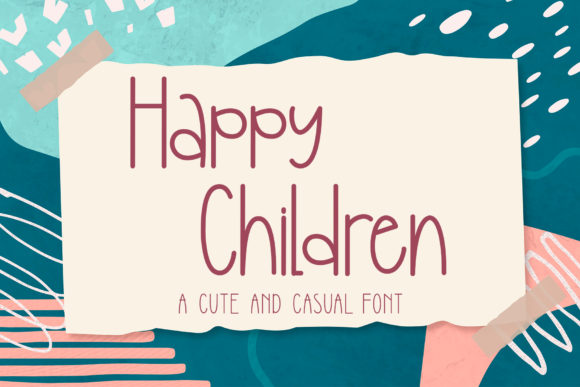
For educators, curriculum designers, homeschooling parents, and creative professionals who value sincerity over slickness, Happy Children is more than just a font—it’s a thoughtful design choice that bridges the gap between professionalism and personality. This cute and thin handwritten typeface mimics natural chalk-on-blackboard lettering, offering an authentic, human touch that resonates deeply in learning environments and heartfelt visual communication.
Unlike overly polished digital fonts, Happy Children embraces subtle irregularities—slight variations in stroke weight, gentle tapering of letters, and organic spacing—that mirror how a real person writes with chalk or marker. That authenticity isn’t decorative; it’s functional. It signals warmth, approachability, and intentionality—qualities that matter when you’re designing classroom posters, student handouts, welcome banners for early childhood programs, or social media graphics for parent engagement initiatives.
Why Educators and Designers Reach for Happy Children
Many professionals face recurring challenges when selecting fonts for educational materials: text that feels too rigid can unintentionally distance young learners; overly playful fonts may undermine credibility; and generic sans-serifs often lack emotional resonance. The goal isn’t just legibility—it’s connection. Teachers want students to feel seen. Curriculum developers aim to reinforce nurturing values. Nonprofits crafting outreach materials need clarity *and* compassion.
Happy Children meets those goals by offering a balanced voice: friendly enough for kindergarten walls, refined enough for professional development handouts, and versatile enough for both print and digital use. Its thin weight ensures readability at small sizes (e.g., labels on learning centers), while its generous x-height and open counters keep letters distinct—even for emerging readers or those with visual processing needs.
Practical Applications Across Learning Environments
Here’s where Happy Children shines—not as a novelty, but as a purposeful tool:
- Classroom signage and anchor charts: Use it for daily schedules, behavior expectations, or vocabulary walls. Its handwritten quality reinforces that these tools are made *with* students—not just for them.
- Student-facing worksheets and activity cards: When instructions or prompts appear in Happy Children, they feel less like directives and more like invitations—especially helpful for anxious or reluctant learners.
- Digital learning assets: In Google Slides, Canva, or Seesaw, pairing Happy Children with clean sans-serif body text creates visual hierarchy without sacrificing warmth.
- Parent communication: Newsletters, event flyers, or welcome packets gain sincerity when headlines or quotes appear in Happy Children. It subtly communicates care and attention to detail.
- Early literacy resources: Because its letterforms closely resemble common handwriting models taught in preschool and kindergarten, it supports letter recognition and formation practice—making it ideal for tracing sheets or phonics flashcards.
Getting the Most From Happy Children: Smart Implementation Tips
Like any design element, Happy Children works best when used intentionally—not everywhere, but where it adds meaning. Here’s how to apply it effectively:
- Reserve it for headings, quotes, and short statements. Its charm lies in contrast. Pair it with a highly legible, neutral font (like Open Sans or Lato) for body copy to maintain readability and visual balance.
- Test contrast and size in context. On chalkboard backgrounds or dark-themed slides, ensure sufficient lightness or stroke definition. At smaller sizes (under 14pt), preview how “i”, “l”, “1”, and “0” render—some handwritten fonts blur distinctions between similar characters.
- Consider your audience’s needs. For neurodiverse learners or students with dyslexia, avoid using Happy Children for extended reading passages. Instead, leverage its emotional resonance in titles, affirmations (“You’ve got this!”), or growth-mindset prompts.
- Use consistent styling across materials. If you choose Happy Children for your school’s welcome banner, carry that same font into your orientation handouts or digital intake forms—creating cohesive, trustworthy branding.
Different Users, Shared Intentions
How Happy Children is applied varies meaningfully by role—and that flexibility is part of its strength:
A preschool teacher might use it for name tags and emotion charts, prioritizing familiarity and emotional safety. A curriculum coordinator could integrate it into editable lesson plan templates to signal pedagogical warmth without compromising structure. A homeschooling parent may rely on it for custom spelling lists or reward certificates—adding personalization that reinforces effort over perfection. Meanwhile, a nonprofit designer creating advocacy materials for early childhood education might choose Happy Children for pull quotes from caregivers or educators, grounding data-driven messaging in human experience.
What unites these users isn’t just aesthetic preference—it’s a shared commitment to making learning feel inclusive, intentional, and joyful. Happy Children supports that mission not through gimmickry, but through quiet authenticity.
Final Thoughts: Choosing Meaning Over Trend
In a world saturated with fast-turnaround design tools and AI-generated visuals, choosing a font like Happy Children is a small but meaningful act of intention. It says: *I value the human rhythm of learning. I honor the quiet effort behind every child’s progress. I design not just to inform—but to invite.*
It won’t solve systemic challenges in education—but it can soften transitions, deepen engagement, and remind everyone involved—teachers, students, families—that care lives in the details. Whether you're printing a bulletin board for a toddler classroom or designing a slide deck for a district-wide workshop, Happy Children offers a gentle, consistent way to center warmth without sacrificing clarity.
If you’re looking for a font that reflects the heart of your work—not just its function—Happy Children deserves a place in your toolkit. Download it, test it in context, and notice how even a single line of text can shift tone, build trust, and quietly say: *This space is made with you in mind.*