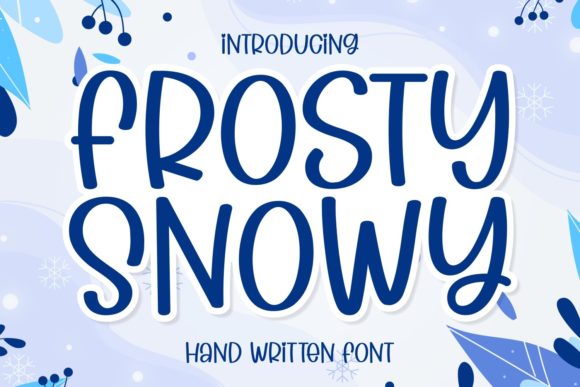
Frosty Snowy: A Handwritten Font That Brings Warmth and Authenticity to Your Educational and Creative Projects
When you're designing classroom posters, crafting chalkboard-style quotes for a cozy café menu, or preparing engaging lesson materials for young learners, authenticity matters. Not just visually—but emotionally. That’s where Frosty Snowy stands out: a cute, playful, and intentionally imperfect handwritten font designed to mimic real chalk on slate or marker on a whiteboard. Its gentle irregularities—slight variations in stroke weight, subtle wobbles, and organic spacing—aren’t flaws. They’re features that invite connection, warmth, and approachability.
Many educators, small business owners, and content creators face the same quiet challenge: how to make digital materials feel human. Slideshows with sterile sans-serifs can feel distant. Overly polished scripts may lack personality. And generic “handwritten” fonts often look stiff, robotic, or cartoonish—undermining credibility instead of building it. You need something that feels genuine, not gimmicky; professional enough for school administrators or clients, yet warm enough for students, parents, or customers to trust and engage with.
Frosty Snowy meets that need head-on. Unlike fonts that simulate handwriting with rigid uniformity, Frosty Snowy was crafted to reflect the natural rhythm of a person writing thoughtfully—not hurriedly, not perfectly, but with intention and charm. That authenticity translates directly into better engagement: students linger longer on vocabulary posters, parents pause to read classroom announcements, and café patrons smile at a seasonal special written in Frosty Snowy.
Consider these everyday situations—and how Frosty Snowy helps:
- Early childhood educators building literacy centers: Use Frosty Snowy for sight-word cards, alphabet banners, or emotion charts. Its friendly curves and open letterforms support visual recognition without overwhelming young eyes.
- Teachers creating differentiated materials: Pair Frosty Snowy with clean, highly legible body fonts (like Open Sans or Nunito) for headings or labels. This contrast adds hierarchy while keeping tone consistent and inviting.
- Small business owners designing in-store signage or social media graphics: Frosty Snowy lends handmade credibility to bakery chalkboards, boutique sale tags, or wellness studio affirmations—without requiring actual chalk or calligraphy skills.
- Curriculum designers and edtech creators: Embed Frosty Snowy in printable worksheets, interactive PDFs, or LMS banners to soften digital interfaces and reinforce a student-centered, nurturing learning environment.
The outcomes are practical and measurable. Teachers report higher student interaction with bulletin boards using Frosty Snowy. Small business owners note increased dwell time on printed menus and improved photo shares of in-store signage on Instagram. And instructional designers find that learners perceive materials as more accessible and less intimidating—especially when supporting neurodiverse or English language learners who benefit from visual warmth and reduced cognitive load.
To get the most from Frosty Snowy, keep these recommendations in mind:
- Use it purposefully—not everywhere. Reserve Frosty Snowy for headlines, quotes, labels, or short phrases. Avoid long paragraphs; its charm shines brightest in bite-sized, high-impact text.
- Pair it wisely. Contrast is your friend. Combine Frosty Snowy with a neutral, highly readable sans-serif (e.g., Inter, Lato, or Montserrat) for body copy. This pairing balances personality with clarity.
- Adjust tracking and size intentionally. Slightly increased letter spacing (5–10% more than default) helps preserve legibility, especially at smaller sizes or on lower-resolution prints. For classroom posters, aim for at least 36pt for headings viewed from 3–6 feet away.
- Test across contexts. Preview Frosty Snowy on both screen and print. Because it mimics chalk, it performs exceptionally well on textured paper or matte finishes—but may soften slightly on glossy stock or backlit displays. When in doubt, increase stroke contrast or add a subtle shadow for readability.
Different users will approach Frosty Snowy in ways that reflect their goals and constraints. A busy elementary teacher might download the free version for quick Canva posters before school starts. A curriculum developer may license the full family—including stylistic alternates and multilingual support—for system-wide consistency across district materials. A freelance designer could use Frosty Snowy as a signature element across client branding packages—helping bakeries, yoga studios, and preschools all communicate care through typography alone.
It’s also worth noting how Frosty Snowy supports inclusivity—not through overt design statements, but through quiet, consistent humanity. Its relaxed proportions and gentle shapes avoid the sharp angles or exaggerated quirks that can unintentionally signal “childish” or “unprofessional.” Instead, it lands in a thoughtful middle ground: friendly without being frivolous, personal without being informal, distinctive without being distracting.
Implementation doesn’t require technical expertise. Frosty Snowy is available in standard OTF and TTF formats, compatible with Canva, Google Slides (via upload), Adobe Creative Cloud, Microsoft PowerPoint, and most major design and word-processing tools. No plugins or subscriptions needed—just install, select, and type. And because it’s optimized for web-safe rendering, it works reliably in HTML emails, learning management systems, and even basic PDF exports.
Finally, think beyond the obvious. While Frosty Snowy excels in education and hospitality, creative professionals are using it in unexpected ways: therapists embedding it in guided journal prompts, nonprofit teams applying it to donor appreciation cards, and even engineers using it in internal training decks to soften complex technical concepts. The common thread? A desire to lead with empathy—even through typography.
If your goal is to make information feel more welcoming, learning feel more joyful, or communication feel more sincere, Frosty Snowy isn’t just another font choice. It’s a subtle but powerful tool for human-centered design—one that reminds us that how something looks affects how it’s received, remembered, and acted upon. Start small: replace one sterile heading this week. Print it. Hold it. See how it changes the feeling of the page. That’s the first step toward designs that don’t just inform—but connect.