Simple Story: A Handwritten Typeface That Adds Warmth and Personality to Your Creative Projects
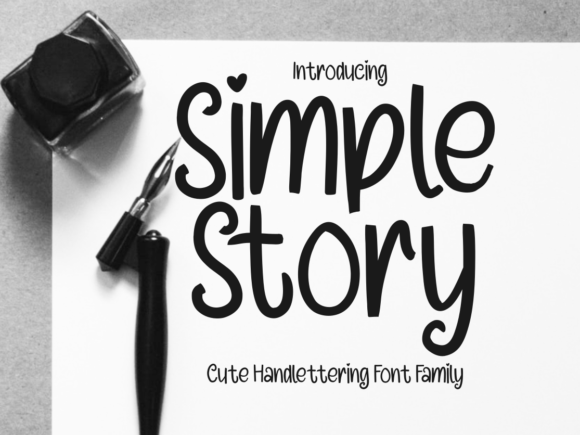
When you're designing a birthday card, hand-lettering a wedding invitation, or printing a cozy quote for your living room wall, the right font does more than convey words—it conveys feeling. Simple Story is a handwritten typeface designed with that intention in mind: to bring authenticity, softness, and approachability to everyday design tasks. As its name suggests, it’s uncluttered, intuitive, and refreshingly human—featuring slim, gently tapered strokes drawn with quiet confidence. It doesn’t shout; it smiles. And for adults who value sincerity over flashiness in their creative work, Simple Story delivers exactly what it promises.
Why Choosing the Right Handwritten Font Matters More Than You Think
Many people underestimate how much typography influences emotional response. A stiff, overly geometric sans serif might feel efficient—but cold. A highly ornate script can feel elegant—but distant or hard to read. When your goal is connection—whether greeting a friend, honoring a milestone, or expressing gratitude—you need a typeface that feels like a thoughtful gesture, not a generic template.
This is where users often hit a common roadblock: they want something personal but struggle to find fonts that balance legibility, warmth, and versatility. Some handwritten fonts are too decorative for body text. Others lack consistent spacing or feel digitally “perfect,” losing the organic charm of real handwriting. Still others require advanced software knowledge or licensing complexity—barriers that derail simple, joyful creativity.
How Simple Story Solves Real Design Challenges
Simple Story was built to meet those needs head-on. Its slender, flowing lines are carefully spaced and proportioned—not so delicate that they vanish at small sizes, nor so bold that they overwhelm subtle layouts. Because it’s intentionally minimal, it scales beautifully across formats: from 12-point captions on a handmade gift tag to 72-point headlines on a framed print.
Unlike many script fonts, Simple Story includes full Latin character support—including punctuation, numerals, and common accented letters—so it works reliably for English-speaking users and multilingual projects alike. Its OpenType features are straightforward (no hidden glyphs or confusing alternates), making it ideal for beginners using Canva, Cricut Design Space, or even basic word processors with font embedding capabilities.
Practical Ways to Use Simple Story—Today
You don’t need a design degree to get meaningful results with Simple Story. Here’s how everyday creators are putting it to work:
- Handmade cards and stationery: Pair Simple Story with a warm kraft paper background and soft watercolor accents—the result feels intimate and intentional, never mass-produced.
- Wedding and event signage: Use it for place cards, menu boards, or ceremony programs. Its gentle rhythm invites guests in without demanding attention.
- Digital greetings and social posts: In email newsletters or Instagram Stories, Simple Story adds visual warmth to otherwise flat layouts—especially when layered over neutral tones or soft textures.
- Educational and therapeutic materials: Teachers, counselors, and wellness practitioners report that Simple Story helps make worksheets, affirmation cards, and journal prompts feel more inviting and less clinical.
- Small business branding touches: While not suited as a primary logo font, it shines in secondary applications—like handwritten-style product labels, thank-you notes tucked into orders, or seasonal banners for local shops.
What to Keep in Mind Before You Begin
Like any tool, Simple Story works best when matched thoughtfully to your goal. First, consider contrast: because its strokes are fine, it pairs especially well with bolder, grounded typefaces (think a clean sans serif like Montserrat or Lato) for headings and body text. Avoid pairing it with other delicate scripts—that can create visual competition instead of harmony.
Second, test readability early. While Simple Story performs well at medium-to-large sizes, avoid using it below 14pt for extended reading—especially in printed materials or low-resolution digital displays. If you’re designing for accessibility, always pair it with sufficient color contrast (e.g., dark gray on off-white, not light gray on beige).
Third, licensing matters. Simple Story is available under clear, user-friendly licenses—including options for personal use, small business commercial use, and extended web embedding. Always verify the license scope before deploying it in client work, e-commerce assets, or downloadable templates.
Different Users, Different Approaches—All Supported
A hobbyist crafting personalized baby shower invites may use Simple Story straight out of the box—typing directly into a free design app and printing at home. A graphic designer building a brand identity for a mindful lifestyle studio might layer Simple Story with custom illustrations and tactile paper stocks to reinforce a cohesive, human-centered aesthetic. An educator creating printable mindfulness cards could embed Simple Story into PDFs shared with students—knowing its clarity supports focus without visual fatigue.
What unites these users isn’t technical expertise—it’s the shared desire to communicate care through design. Simple Story meets them where they are: no steep learning curve, no over-engineered features, just honest, graceful letterforms ready to serve purpose before pretense.
Final Thoughts: Simplicity With Substance
In a world saturated with high-gloss templates and algorithm-driven design tools, choosing Simple Story is a quiet act of intention. It reminds us that the most resonant communication often lives in restraint—in the space between strokes, in the rhythm of a line, in the humility of something made to feel seen, not seen-through.
If your next project calls for warmth without whimsy, personality without pretense, or elegance without effort—Simple Story is worth trying. Download a trial version, set a short phrase in your preferred layout tool, and notice how it changes the tone of the page. You’ll likely feel it before you fully understand it: a subtle lift, a sense of ease, the quiet satisfaction of something that simply fits.
Because sometimes, the simplest stories—and the fonts that tell them—are the ones we remember longest.