Kids Handwriting: A Friendly, Flexible Font for Real Projects
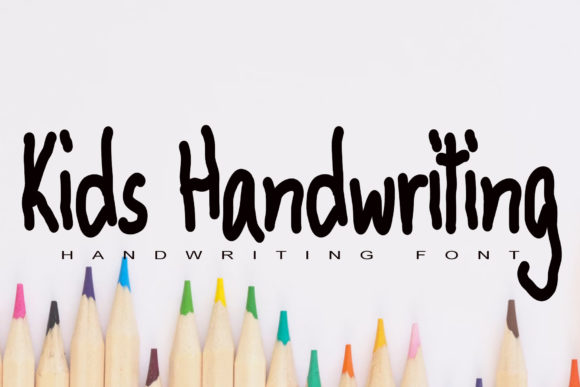
Imagine you’re designing a birthday invitation for your niece’s 7th birthday party. You want it to feel warm and personal—not stiff or corporate—but you also need it to be legible, printable, and easy to pair with photos or simple graphics. That’s where Kids Handwriting steps in: a wavy, gentle handwritten font that looks like it was drawn with a soft-tip marker on lined paper—yet stays clean, consistent, and surprisingly versatile.
It’s not childish in the limiting sense. It’s *childlike*—in the best way: approachable, unhurried, and full of quiet charm. And because it’s intentionally simple—not overly embellished or exaggerated—it avoids looking gimmicky or dated. That balance is why educators use it on classroom posters, small business owners choose it for handmade product labels, and bloggers drop it into Instagram story templates without second-guessing readability.
Where It Fits Naturally (and Where It Doesn’t)
Kids Handwriting shines in contexts where warmth and authenticity matter more than formality. Think: a local bakery’s chalkboard-style menu board, a homeschooler’s weekly reading log, or a therapist’s printable mindfulness journal for tweens. It works because it feels human—not algorithmic, not sterile, not overdesigned.
But it’s not a universal replacement for every font. You wouldn’t use it for legal disclaimers, technical documentation, or dense blog body text. Its rhythm is relaxed, so extended reading can fatigue the eye. That’s not a flaw—it’s a feature. Like choosing a wool sweater over a polyester shirt, you pick Kids Handwriting for the right season and setting.
Real-Life Uses Across Different Roles
- Educators: Teachers print flashcards, behavior charts, or “I Can” statement posters with Kids Handwriting because students recognize it as familiar and non-intimidating. One 2nd-grade teacher told us she switched from Arial to Kids Handwriting for her daily schedule board—and noticed fewer questions about what came next. The font’s gentle curves helped visual scanning without sacrificing clarity.
- Small Business Owners: A candle maker in Portland uses Kids Handwriting on her soy wax jar labels (“Lavender + Rain”, “Maple + Smoke”) alongside a clean sans-serif for ingredients. The contrast feels intentional—not cutesy—and aligns with her brand’s cozy, grounded vibe. Customers often comment on how “handmade” the packaging feels—even though it’s professionally printed.
- Bloggers & Content Creators: A parenting blogger embeds Kids Handwriting in Canva templates for free downloadable checklists (“Back-to-School Supply Tracker”, “Summer Reading Bingo”). Subscribers love the tactile, low-pressure aesthetic—it doesn’t shout, and it doesn’t overwhelm. She reports higher download rates when using this font versus bolder script alternatives.
- Hobbyists & Crafters: Someone making custom greeting cards on Cricut or Silhouette software chooses Kids Handwriting for its smooth vector outlines and generous spacing. No awkward overlaps, no thin strokes that vanish when cut at small sizes. It scales down to 14pt and still reads cleanly on a gift tag.
- Freelancers & Designers: When pitching to clients who run boutique preschools or children’s book illustration services, designers include Kids Handwriting in mood boards—not as the only typeface, but as a supporting voice. It signals understanding: “I get your audience. I respect their attention span and emotional tone.”
Why Simplicity Isn’t Just Cute—It’s Strategic
What makes Kids Handwriting work across so many scenarios isn’t just its look—it’s its restraint. There are no dramatic swashes, no inconsistent baseline shifts, no competing weights. Every letter sits comfortably on the line, with open counters and friendly proportions. That means:
- You can layer it over busy backgrounds (a watercolor texture, a photo of kids’ artwork) and still keep focus on the words.
- It pairs effortlessly with neutral fonts like Inter, Lato, or even Georgia—no font pairing anxiety required.
- It translates well to both digital and print: no hinting issues on screens, no ink bleed on uncoated paper.
This kind of reliability matters when you’re juggling multiple roles—say, a freelance graphic designer who also runs a side Etsy shop selling printable planners. You don’t have time to troubleshoot kerning or test five font variations. With Kids Handwriting, you know what you’ll get: consistent, calm, and quietly confident.
Things to Keep in Mind Before You Use It
Before downloading or licensing Kids Handwriting, consider three practical things:
- Licensing scope: Is it free for personal use only? Does the commercial license cover digital products (like Canva templates you sell), physical goods (stickers, mugs), or both? One educator accidentally used a “free for personal use” version on a paid TPT resource—and had to reformat everything after receiving a notice. Check the license first—not after.
- Character set: Does it include accented characters (é, ñ, ü) if you serve bilingual families or teach world languages? Some versions stop at basic A–Z, which limits usability in real classrooms or multicultural businesses.
- File format & compatibility: Most come as OTF or TTF—both widely supported—but if you use older design tools (or certain web platforms), verify it loads correctly. Test it in your actual workflow: paste a sentence into your email newsletter builder, try it in your POS system’s receipt template, or preview it on your phone before committing.
More Than Just a Font—A Tone-Setting Tool
At its core, Kids Handwriting is a subtle communication tool. It doesn’t say “Look at me!”—it says “You’re safe here.” That resonance shows up in unexpected places: a grief counselor’s handout for children coping with loss, a pediatrician’s waiting room poster about handwashing, a nonprofit’s donor thank-you card mailed to grandparents. In each case, the font helps soften the message without diluting its importance.
And because it’s not tied to a single trend (think: hyper-realistic brush scripts or ultra-thin minimalist fonts), it ages well. A flyer designed with Kids Handwriting in 2023 won’t scream “2023” by 2026. It simply feels timeless in its sincerity.
If you’ve ever hesitated to add handwriting to a project—worried it might look amateurish, inconsistent, or hard to read—you might find Kids Handwriting is the middle ground you didn’t know you needed. Not too polished, not too rough—just right for the moments, messages, and people that matter most.